When your KitchenAid refrigerator suddenly stops working, food safety becomes an immediate concern. These premium appliances typically deliver years of reliable cooling, but when problems strike, knowing how to diagnose the issue can save you from unnecessary service calls or prevent food spoilage. This guide provides step-by-step solutions for the most common reasons your KitchenAid fridge may have stopped functioning properly.
A KitchenAid refrigerator not working properly could stem from simple power issues, failed components, or more complex system malfunctions. By following this systematic approach, you’ll identify whether you can fix the problem yourself or need to contact a certified technician. You’ll learn to diagnose electrical issues, compressor problems, defrost system failures, and other common malfunctions that disrupt your KitchenAid refrigerator’s operation.
Power Supply Problems: First Checks for KitchenAid Fridge Failure
Before examining internal components, verify your KitchenAid refrigerator is receiving proper electrical power. Many “not working” situations resolve with basic electrical troubleshooting that takes just minutes.
Verify Wall Outlet Functionality
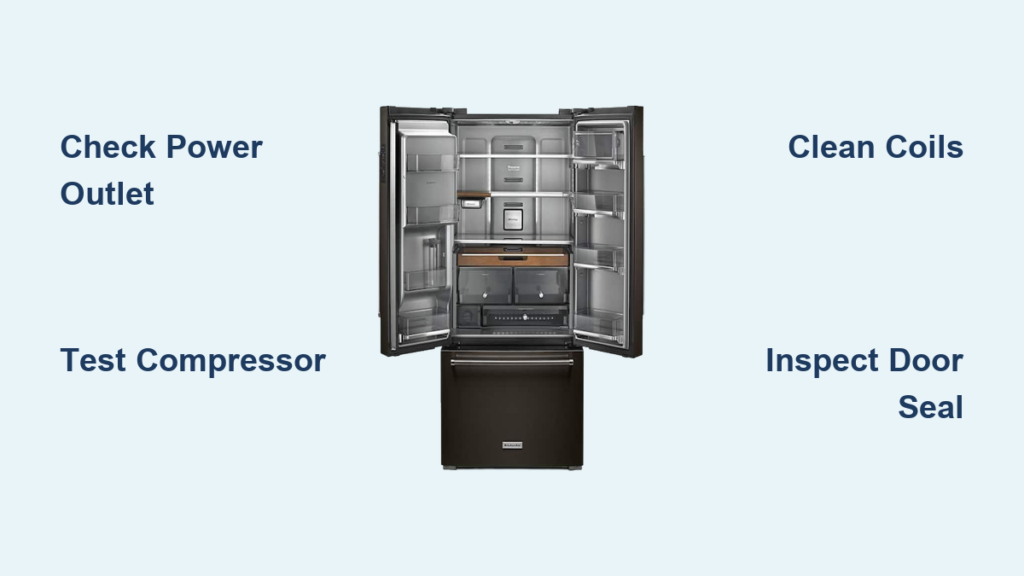
A dead outlet is the most overlooked cause of KitchenAid refrigerator problems. Test the outlet by plugging in a lamp or phone charger you know works. If nothing powers on, you’ve found your issue. For KitchenAid refrigerators, the outlet should provide 120 volts AC (acceptable range: 106-127 volts). Test with a multimeter by inserting one probe into each vertical slot. KitchenAid recommends dedicated circuits—15-amp minimum for standard models and 20-amp for units with ice makers.
Check Circuit Breaker Panel Immediately
Locate your home’s electrical panel and identify the breaker for the refrigerator circuit. A tripped breaker sits in the middle position or has flipped completely off. Reset it by moving fully to “off” then back to “on.” Warning: If the breaker trips immediately upon reset, a short circuit exists—this requires professional service, not a simple reset.
Inspect Power Cord for Damage
Examine the entire power cord length for visible damage like cuts, fraying, or melted insulation. Pay special attention to areas where the cord bends around the refrigerator’s base. Damaged cords require complete replacement with manufacturer-approved parts matching your specific KitchenAid model. Never attempt temporary repairs on damaged cords—they pose serious fire hazards.
Compressor Not Running: Critical Diagnostic Steps

The compressor is the heart of your KitchenAid refrigerator’s cooling system. When it fails to start, cooling stops entirely. Identifying compressor issues requires systematic electrical testing.
Test Compressor Terminals Properly
Locate the compressor at the rear bottom of your KitchenAid refrigerator. You’ll find three terminals labeled “S” (start), “R” (run), and “C” (common). With power disconnected, use a multimeter set to resistance measurement to test between all terminal pairs:
- S to C: Should read 5-15 ohms
- R to C: Should read 5-15 ohms
- S to R: Should read 10-30 ohms
Infinite or zero readings indicate compressor winding failure requiring professional replacement.
Address Start Relay and Capacitor Issues
A failing start relay often produces clicking sounds as the compressor attempts to start but fails. Remove the relay near the compressor and shake it gently—a rattling sound confirms internal failure. Many KitchenAid refrigerators also use start capacitors; inspect for bulging tops or leaking fluid. Test with a capacitor tester—readings must be within 10% of the rated microfarad value. Replacement parts must match exact specifications.
Refrigerator Not Cooling: KitchenAid-Specific Fixes
When your KitchenAid refrigerator runs but fails to maintain proper temperatures—above 40°F in the fresh food compartment or above 10°F in the freezer—multiple system components require evaluation.
Clean Condenser Coils Thoroughly
Dirty condenser coils reduce cooling efficiency. Located behind the rear access panel or beneath the refrigerator, these coils accumulate dust and pet hair over time. Clean them using a coil cleaning brush and vacuum, moving along the coil fins in their natural direction to avoid damage. KitchenAid recommends cleaning coils at least twice annually, or quarterly in homes with pets—this simple task often restores proper cooling.
Check Airflow Restrictions Immediately
Proper cold air circulation requires unobstructed passages between compartments. Inspect for items blocking rear wall vents and verify the damper control opens and closes properly. Ensure food packages don’t block interior air pathways. Restricted airflow creates temperature imbalances where the freezer might over-freeze while the refrigerator section remains too warm.
Test Door Seal Integrity with Simple Method
Compromised door gaskets allow warm air infiltration. Test by closing the door on a dollar bill—resistance should hold the bill firmly when pulled. If the bill slides out easily, the seal has weakened. Clean gaskets with mild soap solution and apply gasket conditioner to maintain flexibility. Damaged gaskets require model-specific replacement.
Frost Buildup in Freezer: Defrost System Solutions

Excessive frost accumulation (more than ¼ inch) on the evaporator coil indicates your KitchenAid refrigerator’s defrost system has failed. Frost-free models automatically defrost through periodic heating cycles.
Defrost Heater Testing Protocol
Disconnect power and access the heater terminals. Test with a multimeter—normal resistance ranges from 15-50 ohms depending on your KitchenAid model. Infinite or zero readings indicate heater failure. Visually inspect for burned sections or damaged elements. Replace with exact manufacturer-specified heater assembly to restore defrost function.
Defrost Thermostat Verification Steps
The defrost thermostat monitors evaporator temperature. Test by disconnecting wires and measuring continuity at temperatures below the threshold (typically below 38°F). The thermostat should show continuity when cold and open circuit when warmed above its operating point. Failure to open when warm prevents proper defrost cycle termination.
Ice Maker Malfunctions: Restore Ice Production
When your KitchenAid refrigerator’s ice maker stops producing ice, the issue typically involves water supply, electrical components, or the ice maker module itself.
Verify Water Supply Connection First
Ice makers require consistent water supply at proper pressure (20-120 psi). Inspect the inlet valve connection at the refrigerator rear, verify the supply line isn’t kinked, and confirm the household water filter isn’t clogged. Frozen water lines within the door prevent water delivery—thaw by increasing compartment temperatures temporarily or using a hair dryer on low setting.
Test Ice Maker Module Operation
Initiate a harvest cycle manually—most ice makers feature a test/reset lever or button. Normal operation produces a complete cycle of approximately 90-120 minutes including water fill, freezing, and ejection. Failure to advance through cycle stages indicates module replacement is necessary. Clean annually with 10% white vinegar solution to remove mineral deposits.
Water Dispenser Problems: Quick Fixes
A non-functioning water dispenser in your KitchenAid refrigerator typically stems from supply issues or component failures.
Replace Water Filter Immediately
Water filters require replacement every 6 months or 200 gallons. A saturated filter restricts water flow and causes dispenser problems. Check your filter’s age and replace it with an authentic KitchenAid filter before pursuing other diagnostics—the dispenser flow rate often improves significantly after replacement.
Check Inlet Valve Function
Test the inlet valve solenoid for electrical continuity with a multimeter—absence of continuity indicates valve failure. Also inspect the inlet valve screen for debris accumulation by disconnecting the water line. Clear any debris found and restore water flow.
Decode KitchenAid Error Codes Quickly
Modern KitchenAid refrigerators with electronic displays provide diagnostic error codes indicating specific system malfunctions:
- PF (Power Failure): Indicates power interruption—press any button to clear
- dF (Defrost Failure): Signifies defrost system malfunction—check heater, thermostat, timer
- E1/E2/Sensor Codes: Temperature sensor failures—locate referenced sensor and test
- FF/Fr: Compartment temperatures too warm—check seals, airflow, compressor
- Sr (Service Required): General system error requiring professional diagnosis
When to Call a Certified Technician
Certain repairs require professional service due to complexity and safety concerns:
- Sealed system repairs: Refrigerant handling requires EPA certification
- Electronic control board replacement: Requires precise programming
- Complex disassembly: Interior panels have specific reattachment procedures
- Electrical repairs beyond basic components: Wiring repairs pose shock hazards
Pro Tip: Before calling service, document your model/serial number, error codes, and troubleshooting steps already completed—this speeds diagnosis and reduces service costs.
Prevent Future KitchenAid Refrigerator Problems
Follow this maintenance schedule to extend your refrigerator’s lifespan:
- Monthly: Clean exterior handles, inspect door seals, verify level operation
- Quarterly: Clean condenser coils, replace water filter, inspect ice maker
- Semi-annually: Deep clean interior with baking soda solution, clean drain system
- Annually: Schedule professional inspection of sealed system components
Set fresh food compartment between 37-40°F and freezer between 0-5°F for optimal food safety and energy efficiency. Enable energy saver mode during high humidity periods to reduce condensation.
Quick Diagnostic Reference for KitchenAid Fridge Failure
When your KitchenAid refrigerator stops working, follow this priority sequence:
- Verify household power (outlet voltage, circuit breaker, cord integrity)
- Test compressor start components (relay, overload, capacitor)
- Evaluate thermostat and temperature sensors
- Check defrost system components if frost accumulation appears
- Inspect airflow pathways for obstructions
- Verify door seal integrity
- Test control board and associated components
This systematic approach eliminates common causes quickly and identifies the most likely source of your KitchenAid refrigerator problem. Most power-related issues and minor component failures can be resolved with basic tools and knowledge, while complex sealed system repairs should be left to certified technicians.