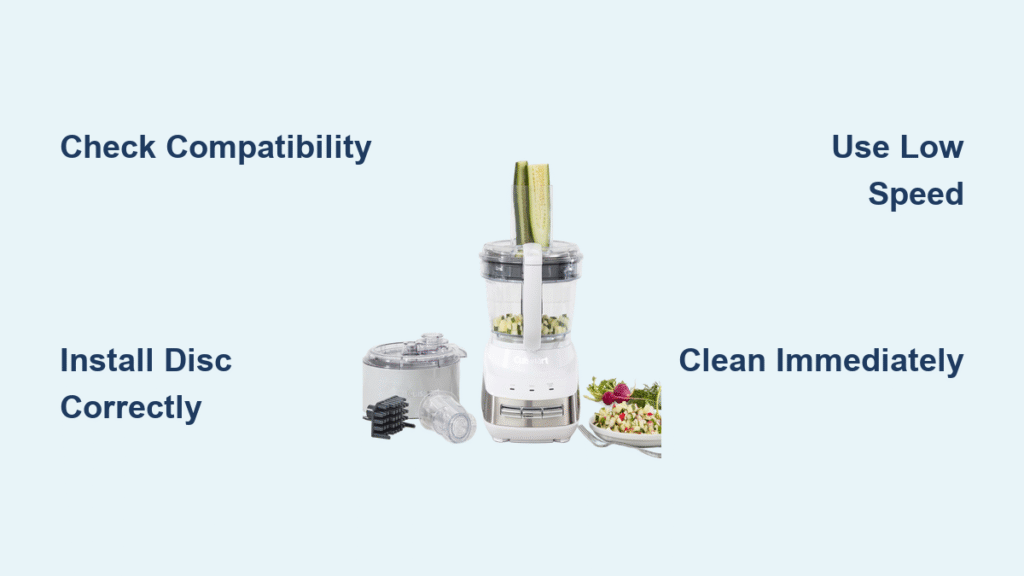
Your Cuisinart dicing kit transforms ordinary food processors into precision dicing machines, producing restaurant-quality 8mm cubes for everything from pico de gallo to French mirepoix. If your diced vegetables look more like uneven chunks than uniform cubes, you’re not alone—most users miss critical installation steps that sabotage results. Mastering the how to use Cuisinart dicing kit process unlocks consistent results in minutes, turning tedious prep work into a 30-second task. This guide reveals the exact techniques Cuisinart test kitchens use to achieve perfect cubes every time, saving you hours of knife work while preventing common frustrations like jammed discs and irregular cuts.
Verify Your Processor Compatibility First
Match Models Before Installation
Don’t waste time installing incompatible kits—check your model number on the processor base immediately. Only these series work with the DG-8 or DG-6 dicing kits: Elemental (FP-8/FP-11), Custom 14 (FP-14), Elite Collection (FP-12), and Prep 9 (DLC-2009). Older units often require the DG-6 variant, while most modern processors use DG-8. Attempting installation on incompatible models like the Mini-Prep series risks permanent damage to your drive shaft. If your model isn’t listed, contact Cuisinart support before proceeding—forcing installation voids your warranty.
Install the Dicing Disc Without Errors

Three-Phase Locking Sequence
Phase 1: Bowl Alignment
Place your work bowl on the base with the handle facing front. Rotate clockwise until you hear a distinct click—this confirms the bowl is locked. Wiggle the bowl; any movement means improper seating that causes dangerous vibration during operation.
Phase 2: Disc Placement
Crucial step: Grip the dicing disc ONLY by the central hub (never touch the 8mm grid). Align the disc’s shaft with the processor’s drive shaft and lower it straight down—no twisting. Gently rotate the disc; it should spin freely. If it sticks, lift and reseat it. Forcing the disc causes grid damage that creates uneven cubes.
Phase 3: Lid Verification
Position the lid so the feed tube aligns with the front. Rotate clockwise until locked. Test the safety interlock by pressing the power button—you shouldn’t hear any motor engagement. If it starts, realign the lid immediately; misalignment is the #1 cause of disc jams.
Perfect Vegetable Dicing Technique
Hard Vegetables: Carrots and Potatoes
- Prep correctly: Peel and cut into 3-inch lengths with squared ends
- Load smartly: Process 2-3 pieces at once (never force more)
- Speed control: Use LOW speed (1-2) with steady pusher pressure
- Yield tip: 1 pound carrots = 3 cups perfect cubes
Pro mistake to avoid: Pushing too hard cracks the grid. If cubes look shredded, reduce pressure and increase speed to MEDIUM (4-5). For potatoes, refrigerate 15 minutes first—cold starch firms texture for cleaner cuts.
Soft Fruits: Tomatoes and Peaches
Critical moisture control: Pat tomatoes dry with paper towels before processing. Cut into 2-inch chunks and process immediately after prep to prevent bruising. Use LOW speed with feather-light pusher pressure—aggressive force turns tomatoes into pulp. For peaches, refrigerate 20 minutes first to firm flesh. Expect 2 medium tomatoes to yield 1.5 cups diced.
Onions and Garlic
Root-end retention: Quarter onions through the root end to maintain structural integrity. Process cut-side down in the feed tube for straight cuts. Never exceed 3 garlic cloves per batch—small quantities prevent clove shattering. Use LOW speed and pulse processing for onions to avoid over-processing. One medium onion yields exactly 1 cup diced when prepped correctly.
Fix These 4 Common Issues Immediately

Irregular Cube Sizes
Cause: Bent grid sections or excessive feed pressure
Solution: Unplug processor, remove disc, and inspect the 8mm grid for visible bends. If damaged, replace the disc. If intact, reduce pusher pressure and increase speed to MEDIUM for dense vegetables.
Ingredients Sticking in Feed Tube
Cause: Overloading or high-moisture produce
Solution: Never exceed 4 cups of prepped ingredients per batch. For watery vegetables like cucumbers, pat dry thoroughly and add a pinch of salt to draw out excess moisture before processing.
Excess Liquid Pooling
Cause: Over-processing tomatoes or zucchini
Solution: Process in 3-second bursts instead of continuous running. Immediately transfer diced items to a colander to drain excess liquid—don’t let them sit in the work bowl.
Disc Vibration During Operation
Cause: Improper disc seating or damaged drive shaft
Solution: Reinstall the disc following Phase 2 precisely. If vibration persists, inspect the processor’s drive shaft for nicks or bends—contact Cuisinart support if damaged.
Clean and Store for Longevity
90-Second Grid Cleaning Method
- Unplug processor and wait 60 seconds for disc stoppage
- Remove lid and lift disc by hub (never touch grid)
- Use the cleaning tool: Insert through grid openings to dislodge trapped bits
- Hand-wash disc with warm soapy water and soft brush—never dishwasher
- Air-dry completely before storage
Storage mistake: Stacking discs causes grid damage. Always store in the provided impact-resistant case. For long-term storage, apply food-grade mineral oil to cutting surfaces to prevent corrosion.
Critical Safety Protocols
Non-Negotiable Safety Rules
- Always use the pusher—fingers in the feed tube cause 90% of dicing kit injuries
- Wear safety glasses when processing hard vegetables like beets or carrots
- Unplug before clearing jams—never reach into the work bowl while plugged in
- Keep children 3+ feet away during operation due to flying debris
If the disc jams, stop immediately and unplug. Wait 60 seconds for complete stoppage before clearing. Forcing ingredients through causes grid warping that ruins future dicing performance.
Pro Recipe Starters
5-Minute Pico de Gallo
Process tomatoes first (2 cups), then onions (½ cup), and jalapeños (¼ cup) separately. Combine with cilantro, lime juice, and salt. Key tip: Dice tomatoes alone—processing with onions waters down flavor.
French Mirepoix Shortcut
Dice equal parts onion, carrot, and celery separately. Store in labeled airtight containers with paper towel lining (3-day fridge life). Use 2:1:1 ratio for perfect stocks—no knife skills required.
Mastering the how to use Cuisinart dicing kit process takes one successful run. Start with firm carrots to build confidence, then progress to delicate tomatoes. Consistent 8mm cubes transform soups, salsas, and stir-fries while cutting prep time by 70%. Remember: gentle pressure, correct speed, and immediate cleaning are your golden rules. For troubleshooting videos, visit Cuisinart.com’s dicing kit resource center—your shortcut to professional results without the chef’s salary.