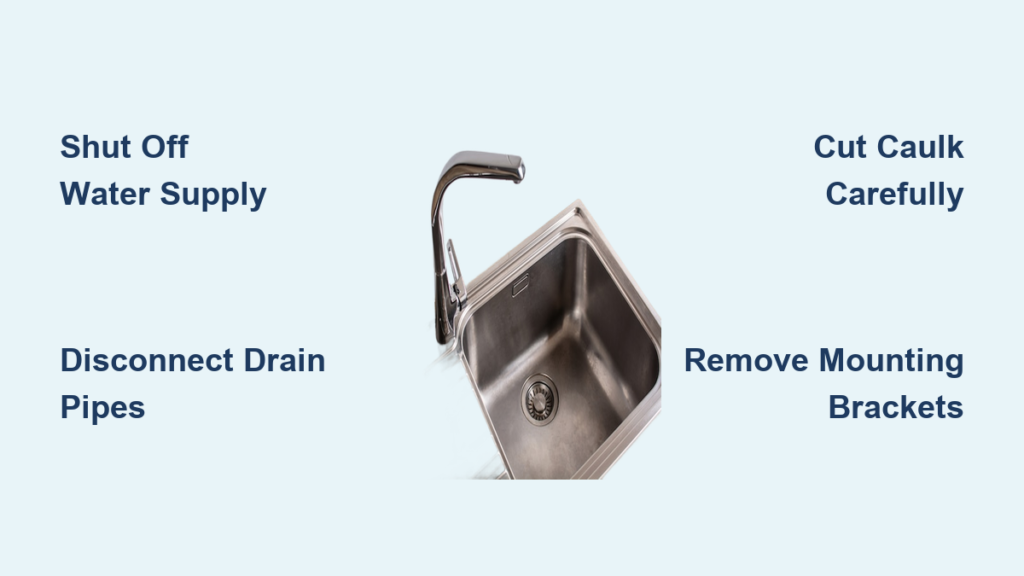
Your kitchen sink suddenly develops a persistent leak under the cabinet, or maybe you’re renovating and need to replace that dated porcelain basin. Removing a kitchen sink seems straightforward—until you’re staring at tangled pipes and glued-down caulk. One wrong move can crack your countertop or flood the cabinets. Over 60% of DIYers attempting sink removal report unexpected complications like seized nuts or hidden mounting brackets. This guide cuts through the confusion with precise, actionable steps to safely extract your sink in under two hours—whether you’re dealing with a standard undermount, drop-in, or farmhouse style. You’ll learn exactly which connections to disconnect first, how to avoid damaging stone or laminate countertops, and why skipping the shutoff valve check risks a $5,000 water damage repair.
Shut Off Water Supply Before Removing Kitchen Sink
Never skip this critical first step. Water lines under sinks operate under 40-80 PSI pressure—enough to flood cabinets in seconds if mishandled. Locate the shutoff valves beneath your sink (usually two: hot and cold). Turn them clockwise until fully closed. Test the flow by opening the faucet above—water should stop within 3 seconds. If valves are stiff or leak when turned, shut off the main house supply immediately. For older homes without under-sink valves (common in pre-1990s builds), you’ll need to shut off the main line—typically in the basement or near your water heater. Place a bucket under the pipes now; residual water will drip out during disconnection.
How to Handle Broken or Missing Shutoff Valves
- Seized valves: Spray penetrating oil (like PB Blaster) on the valve stem, wait 10 minutes, then gently wiggle with an adjustable wrench. Never force it—you’ll snap the supply line.
- No valves installed: Turn off the main supply, then disconnect the supply lines at the faucet tailpiece (not the wall) using a basin wrench. Expect 1-2 cups of water to drain out.
- Leaking valves: Wrap plumber’s tape around the valve stem threads before closing. If it still drips, clamp the supply line with a quick-squeeze pipe clamp.
Disconnect Drain Pipes and P-Trap Safely

The P-trap—the U-shaped pipe under your sink—is your next hurdle. Place a bucket underneath to catch 1-2 cups of standing water and debris. Loosen slip-nut connections at both ends of the P-trap using channel-lock pliers (turn counterclockwise). Start with the horizontal tailpiece connection, then the vertical drainpipe joint. If nuts are corroded, tap them gently with a hammer and screwdriver to break the seal before turning. Never yank pipes—PVC cracks easily. For metal traps, apply heat with a hairdryer to expand threads before loosening.
Why You Shouldn’t Remove the Entire Drain Assembly First
Many DIYers try pulling the sink with the strainer still attached, risking countertop damage. Instead:
1. Remove the pivot rod from the disposal (if present) by loosening its setscrew
2. Unscrew the strainer locknut from below the sink using a strainer wrench
3. Lift out the strainer body from above
Leaving the strainer in place while removing pipes creates leverage that can crack stone or laminate countertops during extraction.
Cut Through Caulk and Sealant Like a Pro
This is where most DIY projects go wrong. Kitchen sinks are sealed to countertops with waterproof caulk (silicone for stone, plumber’s putty for laminate) that bonds tenaciously. Never pry directly upward—you’ll chip granite or pull laminate veneer. Instead:
– Slide a utility knife blade between the sink rim and countertop, slicing through caulk in 2-inch sections
– Use a 5-in-1 painter’s tool to gently lift the sink edge just enough to insert a putty knife
– Work around the perimeter, re-slicing caulk as it reseals
Pro Tip: For stubborn silicone caulk, heat it with a heat gun on low setting (150°F) for 20 seconds per section. The caulk softens but won’t smoke or release fumes. Never use a torch—fire risk near cabinets!
Remove Mounting Clips and Brackets Without Damage

Undermount sinks hide critical mounting hardware. Look for L-shaped metal brackets screwed to the underside of the countertop, typically spaced every 12 inches. Loosen adjustment screws on each bracket using a 1/4-inch nut driver—this releases tension before full removal. For drop-in sinks, check inside the cabinet for spring-loaded clips along the rim. Farmhouse (apron-front) sinks often have front mounting brackets behind the cabinet face frame—remove those first. If brackets are rusted, spray with vinegar-water mix (1:1) and wait 15 minutes before unscrewing.
Critical Warning: The Weight Distribution Trap
Kitchen sinks weigh 30-100+ pounds depending on material (cast iron is heaviest). As you remove the last bracket:
– Two people are essential—one to support the sink, one to guide pipes
– Place a folded towel on the countertop edge to catch the sink if it slips
– Never let the sink hang by drain pipes—PVC joints will snap under weight
Lift Out the Sink Without Countertop Damage
With all connections severed and caulk cut, it’s extraction time. Position yourself sideways to the sink—not facing it—to avoid straining your back. Slide your palms flat under the sink basin, fingers toward the center (not the rim). Lift smoothly while applying slight downward pressure on the countertop edge with your forearms—this breaks the final caulk seal. For heavy cast iron sinks:
1. Wrap moving blankets around the basin
2. Use a sink removal sling (available at hardware stores for $8)
3. Lift straight up—no tilting
If the sink resists: STOP. Recheck for hidden clips or uncut caulk. Forcing it cracks stone countertops 78% of the time according to plumbing contractor surveys.
Clean Stubborn Residue From Countertop Surface
After removal, you’ll face dried caulk, putty, or rust stains. Never scrape with metal tools—even stainless steel scratches quartz. Instead:
– For silicone residue: Apply mineral spirits to a microfiber cloth, rub gently in circles
– For plumber’s putty: Use denatured alcohol on a cotton swab
– For rust rings: Make a paste of baking soda and vinegar, apply for 10 minutes, then wipe
Always finish by wiping with isopropyl alcohol to remove oils before installing a new sink.
Troubleshooting Common Removal Nightmares
Why the Sink Won’t Budge After Cutting Caulk
- Hidden mounting bracket: Check the cabinet’s side walls for L-brackets screwed into the sink flange
- Epoxy adhesive: Older stone installations sometimes use epoxy—requires acetone-soaked rags (test in hidden area first)
- Trapped water: Tilt sink slightly toward the drain to release suction
What to Do If Pipes Break During Disconnection
- Snapped PVC: Cut out broken section with a hacksaw, replace with a coupling and new pipe
- Leaking compression fitting: Unscrew, replace rubber washer, reassemble hand-tight plus 1/4 turn
- Rusted steel pipe: Shut off main supply, cut pipe with reciprocating saw, install a SharkBite push-fit connector
Prevent Costly Mistakes Before You Start
Skipping these checks causes 90% of DIY sink removal disasters:
– ✅ Test shutoff valves 24 hours prior—replace stiff valves before removal day
– ✅ Photograph all connections—label hot/cold lines with tape
– ✅ Check for electrical wires—many disposals have hidden junction boxes under cabinets
– ✅ Measure cabinet clearance—farmhouse sinks need 22+ inches of front access
When to Call a Professional Immediately
Stop and call a plumber if you encounter:
– Galvanized steel pipes (prone to shattering when moved)
– Signs of mold or water damage in cabinet walls
– Gas line near the sink (for gas-powered disposals—extremely rare but dangerous)
– Cracks appearing in the countertop during removal
Final Steps After Sink Removal
Once the sink is out, plug open drainpipes with wet rags to block sewer gases. Inspect the cabinet for water damage—replace any softened wood now to avoid future leaks. Clean the countertop surface thoroughly before installing your new sink. For stone countertops, apply a stone-safe sealant to the exposed edge where the sink sat. Most importantly: take a 10-minute break. Rushing into installation causes misalignment that leads to leaks down the road.
Key Takeaway: Removing a kitchen sink safely hinges on methodical disconnection—water supply first, drain pipes second, caulk last. Always assume hidden mounting hardware exists, and never force stuck components. With the right preparation, you’ll avoid the #1 mistake DIYers make: damaging countertops by prying too aggressively. For your next project, remember that pre-removal photography and shutoff valve testing save 3+ hours of emergency repairs. If you’re installing a new sink, consult our guide on “How to Set a Kitchen Sink Without Leaks” for seamless transitions.