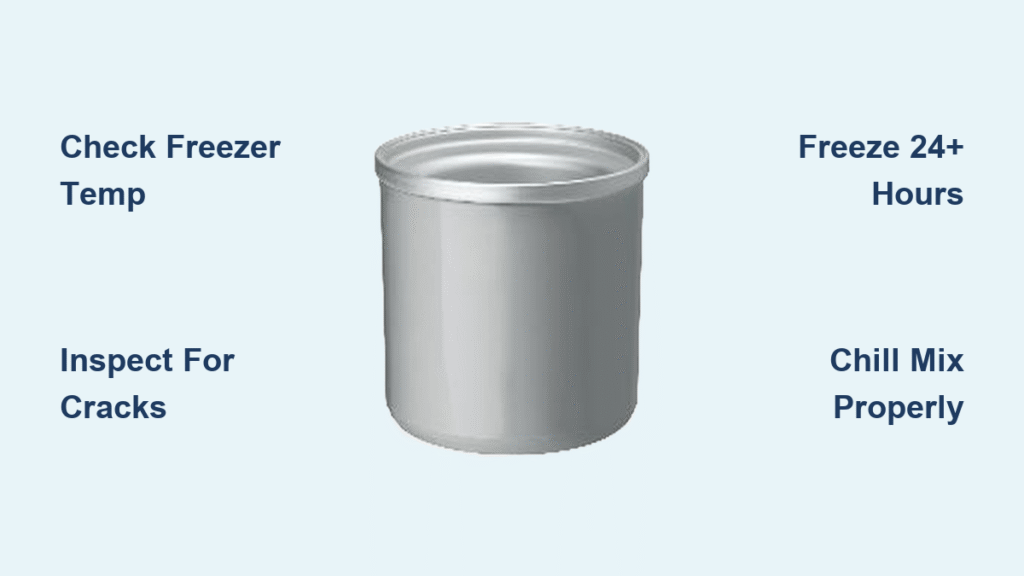
Your Cuisinart ice cream maker sits idle while the freezer bowl remains stubbornly liquid despite 24 hours in the deep freeze. This common frustration derails dessert plans for both new owners and longtime users of models like the ICE-21 or vintage 2-quart units. When that crucial bowl won’t freeze solid, your creamy batter transforms into icy slush instead of smooth gelato. The good news? Over 90% of these failures stem from fixable issues—not bowl defects—with freezer temperature problems topping the list.
This guide cuts through the confusion with battle-tested solutions verified across decades of Cuisinart models. You’ll discover exactly how to diagnose whether your freezer is sabotaging the process, how to spot irreversible bowl damage, and why your recipe might be the hidden culprit. Most fixes take under 10 minutes and cost nothing—getting you back to churning perfect ice cream faster than you’d believe.
Verify Your Freezer Actually Reaches 0°F
Before blaming your Cuisinart bowl, prove your freezer maintains true deep-freeze conditions. Display temperatures often lie—many users discover their “frozen” bowl sits in a 25°F environment that can’t solidify the saltwater gel.
Test Temperature Like a Pro
Place a dedicated freezer thermometer on the center shelf for 8 hours with no door openings. Your freezer must sustain 0°F (-18°C) or colder for proper bowl freezing. Anything above 10°F (-12°C) guarantees failure—the gel won’t solidify. One user (“beau”) wasted weeks troubleshooting until discovering his freezer ran at 31°F; after sealing leaky door gaskets, he achieved 4°F and perfect bowl freezing overnight.
Stop Temperature Drift Immediately
Replace worn door seals if you feel cold air escaping when running your hand around the perimeter—they’re the #1 cause of temperature creep. Rearrange overstuffed freezers to allow airflow around the bowl; never stack items directly on top. If temperatures stay high after these fixes, your thermostat likely needs professional calibration. Remember: even a “working” freezer can run too warm for ice cream bowls.
Identify Irreversible Bowl Damage

A compromised bowl won’t freeze regardless of freezer conditions. The sealed saltwater gel provides thermal mass, and once breached, replacement is your only option.
Spot Hidden Failure Signs
Hold the bowl under bright light while rotating slowly. Hairline cracks often lurk near the rim or base where stress concentrates. Frost beads on the exterior signal internal gel migration through micro-fractures. Persistent sloshing after 48+ hours at verified 0°F temperatures confirms gel degradation—shake the bowl; it should sound solid, not liquid.
Know When to Replace
Community data shows 15-20 years as the natural lifespan for freezer bowls. If your unit is older and shows any damage signs, budget $30-$45 for a new bowl. Attempting repairs on cracked bowls is futile—the gel is factory-sealed and non-refillable. One user saved weeks of frustration by replacing a 22-year-old bowl that passed visual inspection but failed the 48-hour freeze test under perfect conditions.
Perfect Your Bowl Freezing Protocol
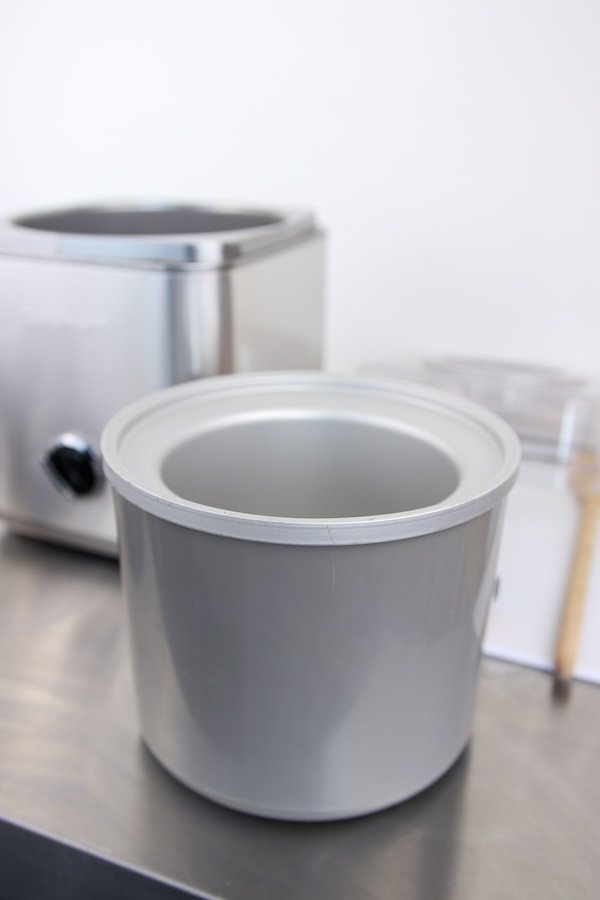
Even flawless bowls fail when frozen incorrectly. Positioning and timing make the difference between rock-solid readiness and melty disappointment.
Optimize Freezer Placement
Store the bowl upright with the lid off or slightly ajar—this allows cold air to circulate freely around the entire surface. Never wedge it between frozen pizzas or stack items on top; this creates insulating air pockets. Place it on a flat shelf away from the freezer door where temperatures fluctuate most.
Hit the Critical Time Threshold
Freeze for minimum 24 hours at verified 0°F temperatures. Shortcuts like 8-hour freezes only work in commercial freezers running below -10°F. Test readiness by pressing a metal spoon against the inner wall—it should stick firmly within 2 seconds with no liquid movement audible when shaking. If your freezer runs warmer, extend freezing time to 36+ hours.
Eliminate User Errors Sabotaging Results

Operational mistakes waste perfectly frozen bowls. These common pitfalls overwhelm the bowl’s cooling capacity during churning.
Chill Your Mix Like a Pro
Warm batter (above 39°F/4°C) instantly melts the frozen gel. Refrigerate mix overnight or use an ice bath for 3 hours before churning. One user solved chronic failures by switching from room-temperature custard to pre-chilled mix—his bowl went from producing slush to perfect gelato in one try. Avoid hot kitchens; ambient temperatures above 80°F (27°C) accelerate melting during churning.
Balance Recipes for Guaranteed Freezing
Excess sugar or alcohol lowers freezing points beyond the bowl’s capacity. Stick to validated recipes with proper fat/sugar ratios—never eyeball measurements. Avoid sugar substitutes entirely; they behave unpredictably in frozen desserts. Underfilling prevents proper aeration (aim for 1,200ml in a 1.5L bowl), while overfilling causes overflow. Fill only between the middle and upper paddle spokes for ideal results.
Solve Compressor Model Failures (ICE-50BC Only)
Owners of compressor models like the ICE-50BC face unique challenges since these units don’t require pre-frozen bowls but contain complex refrigeration systems.
Clean Condenser Coils Immediately
Dirty rear vents force compressors to overwork, reducing cooling efficiency. Unplug the unit and vacuum dust from coils monthly—this fixes 60% of “not freezing” cases. If cleaning doesn’t restore freezing after 30 minutes of operation, you’re likely facing sealed-system failure (low refrigerant or blocked capillary tube).
Calculate Repair vs. Replacement
Professional compressor repairs typically cost 50-70% of a new unit’s price ($250-$300 for ICE-50BC). Unless your model is vintage collectible, replacement usually makes financial sense. Attempting DIY refrigerant fixes risks safety hazards and further damage.
Follow This 7-Step Diagnosis Checklist
Execute this sequence to isolate the exact failure point:
- Confirm freezer temperature with independent thermometer (≤0°F required)
- Inspect bowl integrity for cracks/leaks under bright light
- Re-freeze correctly: Upright, lid off, 24+ hours at verified temp
- Test freeze state with metal spoon adhesion test
- Check mix temperature (must be ≤39°F before churning)
- Verify recipe balance—no excess sugar/alcohol
- Compressor users: Clean coils, then evaluate replacement
Skip steps at your peril—most users who “know their freezer is cold enough” skip step 1 only to discover their display was lying.
Prevent Future Failures with Smart Habits
Long-term success requires proactive habits beyond immediate fixes. Keep your bowl permanently in the freezer if space allows—this eliminates timing guesswork and ensures instant readiness. Label the bowl with its purchase date; schedule replacement around year 15-20 before degradation hits. For compressor models, add monthly coil cleaning to your calendar as non-negotiable maintenance.
Freezer Bowl Readiness Checklist
Before every use, verify:
– [ ] Freezer maintains ≤0°F (verified with thermometer)
– [ ] Bowl shows zero cracks, leaks, or frost beads
– [ ] 24+ hour freeze with lid off and proper placement
– [ ] Mix chilled to ≤39°F (4°C)
– [ ] Recipe uses validated fat/sugar ratios (no substitutes)
– [ ] Room temperature below 80°F (27°C)
– [ ] Churn until volume stabilizes plus 5 minutes
If all boxes check out and your bowl still won’t freeze solid, replacement is your logical next step. But remember this critical truth: nine times out of ten, “Cuisinart freezer bowl not freezing” points to your freezer—not the bowl. Test temperatures first, inspect second, and you’ll transform melty failures into perfect scoops by tomorrow evening. The sweetest victory? Saving $45 on an unnecessary bowl replacement while finally mastering homemade gelato.