
Your Cuisinart Keurig sits idle on the counter, water sloshing inside its hidden reservoir as you prepare to ship it cross-country or tuck it into storage. You’re staring at that full tank wondering: how to empty water from Cuisinart Keurig coffee maker without triggering leaks or voiding your warranty? While newer models make drainage simple, older units like the SS-700 hide water in internal tanks requiring surgical precision. One wrong move could fry the heating element or create permanent leaks.
This guide reveals exactly how to remove every drop safely—whether you have a detachable reservoir or need to access the SS-700’s hidden internal tank. You’ll discover when full drainage is actually necessary (hint: 90% of moves don’t require it), step-by-step procedures that prevent $200 repair bills, and critical mistakes that turn a simple task into a coffee maker killer. Most importantly, you’ll learn how to protect your warranty while getting the job done.
When Full Drainage Becomes Non-Negotiable
Skip Drainage for Routine Moves and Storage
Modern Cuisinart Keurig models are engineered to hold water safely between uses. That water prevents air bubbles from clogging internal lines and keeps the system primed for your next brew. For countertop-to-cabinet moves or short-term storage under three months, simply remove the external reservoir. The residual water in hidden compartments won’t leak during transport and actually protects against system damage. Forgetting this could mean unnecessary disassembly that voids your warranty.
Drain Only for These Critical Situations
- Long-term storage exceeding 90 days to prevent bacterial growth and mineral deposits
- Cross-country shipping where temperature shifts could freeze and crack internal tanks
- Professional movers requiring empty appliances (get written proof first)
- Vacation home winterization where freezing temperatures threaten plumbing
Quick Drain Method for Detachable Reservoir Models
Immediate Steps for Safe Water Removal
If your Cuisinart model (like the SS-5, SS-10, or SS-15) has a lift-off reservoir, follow this 60-second procedure:
- Unplug completely – wait 30 minutes after last use for internal cooling
- Lift reservoir straight up – grip the handle firmly without tilting
- Pour water into sink – leave 1-2 inches to avoid spilling during removal
- Tilt machine 15 degrees – angle toward drip tray over sink for 20 seconds
- Blot accessible areas – use microfiber cloth on visible moisture near brew head
- Air dry upright – leave reservoir off for 2 hours before packing
Pro tip: Never shake your Cuisinart Keurig to force drainage. Gravity naturally pulls water through the drip tray and brew head channels. Aggressive shaking misaligns internal pumps and damages sensor connections.
Cuisinart SS-700 Internal Tank Drainage Protocol
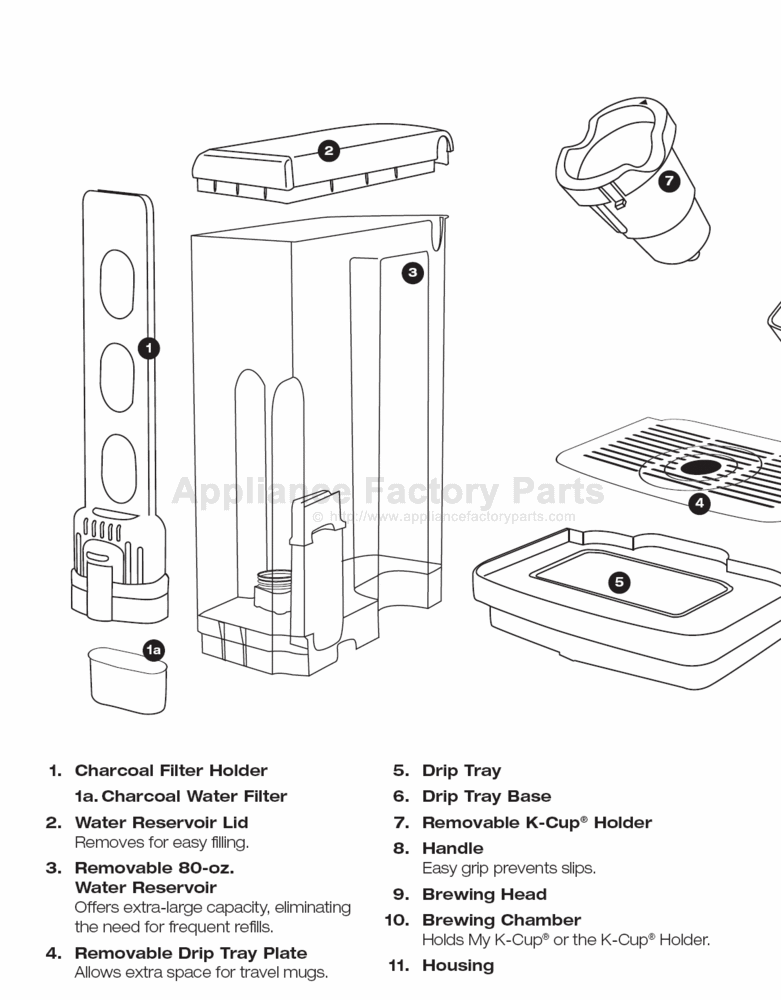
Critical Warranty-Voiding Warning
This procedure permanently voids your warranty. Cuisinart explicitly states in technical documentation that user disassembly of internal tanks constitutes unauthorized modification. If your SS-700 is under warranty, professional service costs less than replacement. Proceed only for long-term storage when shipping companies demand proof of drainage.
Essential Tools for SS-700 Drainage
- Phillips #1 screwdriver (magnetic tip recommended)
- Needle-nose pliers with insulated grips
- 4 clean microfiber towels (no lint!)
- Bright LED work light
Step-by-Step Internal Drainage Process
Workspace Preparation Checklist
- Cool completely – unplug 1 hour before starting to prevent electrical shorts
- Clear 3-foot radius – water spills will spread across countertops
- Towel barrier – create absorbent perimeter around work area
- Position strategically – rotate unit so pump assembly faces downward
Internal Tank Access Sequence
- Remove drip tray – pull straight out without lifting
- Lift water reservoir – set aside carefully
- Flip unit gently – place on soft towel with control panel down
- Locate bottom panel – identify 4-6 screws near center (not corners)
Safe Water Extraction Technique
- Remove screws slowly – bag and label each one to prevent mix-ups
- Identify drain hose – find clear tube connected to copper heater tank
- Pinch clamp with pliers – squeeze metal ring to release hose
- Guide flow – angle hose into container; expect 8-12 oz of drainage
- Tilt incrementally – rotate unit 5 degrees every 30 seconds for complete emptying
- Reconnect securely – push hose fully onto fitting until it clicks
Warning: Forcing the hose connection causes micro-tears that leak during first brew. Test by tugging firmly—if it moves, disconnect and retry.
Reassembly Safety Protocol
- Align panel precisely – mismatched screw holes crack plastic housings
- Hand-tighten screws – overtightening strips plastic threads
- Document drainage – tape “DRAINED – REINITIALIZE” note to unit
- Verify stability – shake gently; any sloshing means incomplete drainage
Post-Drainage Reinitialization Steps
After draining your SS-700, skip this reactivation sequence and the heating element burns out in 45 seconds:
– Fill reservoir to MAX line with filtered water
– Run 4 consecutive water-only brew cycles
– Monitor for:
– Unusual gurgling (air bubbles)
– Steam escaping vents (overheating)
– Leaks at base (hose reconnection failure)
– Discard first 2 coffee brews after reactivation
Professional Drainage Services That Preserve Warranty

Cuisinart-Authorized Technician Options
Call Cuisinart support (1-800-726-0190) for warranty-safe drainage. Their technicians use proprietary tools that access internal tanks without disassembly. Costs range $55-$85 but include:
– System diagnostics pre/post drainage
– Leak testing under pressure
– Official “Drained for Shipping” certification
– Warranty documentation updates
Key insight: Most moving companies accept this certification instead of requiring user drainage. Always get written verification before DIY attempts.
Transport Strategies Without Full Drainage
Short-Distance Move Protocol (Under 50 Miles)
- Remove external reservoir completely
- Place unit upright in original box with padding on all sides
- Insert folded towel in drip tray compartment
- Seal box with “FRAGILE – UPRIGHT ONLY” labels
Long-Distance Shipping Safeguards
- Wrap entire unit in plastic grocery bags (double layer)
- Pack in box 4+ inches larger than appliance on all sides
- Fill voids with crumpled newspaper (never packing peanuts)
- Place “LIQUID INSIDE – THIS SIDE UP” arrows on all panels
Emergency Leak Response During Transit
If water appears during transport:
1. Immediately power off – unplug even if unit is packed
2. Isolate moisture – surround with dry towels inside box
3. Air dry 48 hours before reuse – moisture in electrical components causes shorts
4. Test with water only – never brew coffee until system proves leak-free
Costly Mistakes That Destroy Cuisinart Keurigs

Never Attempt These Drainage Errors
- Running dry after drainage – heating elements fail in under 1 minute without water
- Skipping reinitialization cycles – trapped air bubbles crack internal lines
- Using flathead screwdrivers – strips SS-700’s precision Phillips screws
- Ignoring tilt angles – 20+ degrees damages pump alignment
Warranty-Saving Documentation Tactics
- Photograph each disassembly step with timestamped phone camera
- Store screws in labeled baggies (e.g., “Bottom Panel – Front Left”)
- Keep receipt of professional service for warranty validation
- Retain original packaging for future moves
Model-Specific Drainage Cheat Sheet
Cuisinart Model Drainage Requirements
| Model Series | Reservoir Type | Drain Method | Warranty Risk |
|---|---|---|---|
| SS-5/SS-10/SS-15 | Detachable | Quick method only | None |
| SS-700/SS-300 | Fixed internal | Full disassembly | High |
| Premium Single-Serve | Hybrid | Check manual | Medium |
| Keurig-branded | Varies | Never assume compatibility | Critical |
Finding Your Exact Model Number
Check these locations before attempting drainage:
– Inside water reservoir compartment (stamped near hinge)
– Bottom panel (requires tilting unit)
– Original sales receipt (model SS-XXX format)
– Cuisinart account purchase history
Critical reminder: Keurig-branded units sold through Cuisinart use different internal plumbing. Never apply Cuisinart procedures to Keurig models.
Final verification before moving: If your Cuisinart Keurig model has a detachable reservoir (most post-2018 units), simply removing the tank and air-drying handles 95% of relocation scenarios. Reserve invasive drainage only for SS-700s facing cross-country moves or frozen storage—then strongly consider professional service. Always run multiple water-only cycles after refilling, and never assume all Cuisinart Keurigs share identical drainage procedures. When in doubt, that 10-minute call to Cuisinart support (1-800-726-0190) prevents $150 repair bills and saves your warranty. Your coffee maker’s longevity depends on treating hidden water with surgical precision—not brute force.