Your kitchen faucet suddenly refuses to rotate, trapping you in a frustrating battle every time you need to rinse a large pot or direct water away from the sink. This common issue transforms one of your kitchen’s most functional features into a major inconvenience. The good news is that 90% of faucet swivel problems can be resolved with basic tools and a systematic approach. Most homeowners can complete these repairs in under an hour without professional help. This guide reveals every step to diagnose and fix a stuck kitchen faucet, from identifying the root cause to applying the perfect solution for smooth rotation.
A non-swiveling faucet typically stems from one of four culprits: loose mounting hardware, mineral deposits, worn internal components, or corrosion. Understanding which problem affects your specific faucet saves time and prevents unnecessary disassembly. The spherical joint mechanism that allows rotation depends on precise tension and clean surfaces—when deposits build up or parts wear out, movement becomes restricted. Before grabbing tools, spend five minutes diagnosing your specific issue. Listen for grinding sounds during rotation attempts and check for water pooling around the base, which indicates seal failure. This targeted approach ensures you apply the right fix rather than guessing randomly.
Diagnose Your Specific Swivel Failure Pattern
Before disassembling anything, analyze exactly how your faucet behaves when you try to rotate it. A faucet that won’t move at all usually indicates either a completely seized mechanism or an obstruction blocking rotation. One that turns stiffly but eventually moves often suffers from mineral buildup or insufficient lubrication. Pay attention to directional differences—many faucets bind when rotating toward the sink but move freely away from it, pointing to localized debris on one side of the swivel mechanism.
Perform three simple diagnostic tests that take less than two minutes. First, apply downward pressure on the spout while attempting to rotate—sometimes this relieves binding in the swivel joint. Second, check for lateral movement by gripping the faucet body and pushing side-to-side; excessive play indicates loose mounting hardware. Third, run hot water through the faucet for two minutes then try rotating again—heat sometimes temporarily loosens mineral deposits. These quick checks immediately narrow your repair focus to the most likely causes.
Gather the Right Tools for Effective Repair

Using improper tools risks damaging your faucet’s finish or internal components. For most kitchen faucet repairs, you’ll need an adjustable wrench (10-inch works best), a basin wrench for hard-to-reach mounting nuts, needle-nose pliers, and both flathead and Phillips screwdrivers in multiple sizes. Specialty faucet repair kits containing retaining clip removers cost under $15 at hardware stores and prevent frustrating broken clips during disassembly.
Don’t forget essential consumables that make the difference between a temporary fix and lasting solution. Food-grade silicone plumber’s grease outperforms petroleum-based products by resisting water washout and preventing mineral adhesion. White vinegar dissolves hard water deposits without damaging metal components, while microfiber cloths protect chrome finishes during disassembly. Keep a small container nearby to organize tiny parts—losing a spring or washer during repair doubles your frustration and complicates reassembly.
Secure Loose Mounting Hardware in 3 Minutes
Loose mounting hardware causes more swivel problems than any other single issue. When the large nut beneath your sink loosens, the entire faucet assembly shifts during use, creating uneven pressure that restricts rotation. You’ll notice this problem worsening gradually—you might have needed increasing force to swivel the faucet over weeks or months before it stopped moving entirely.
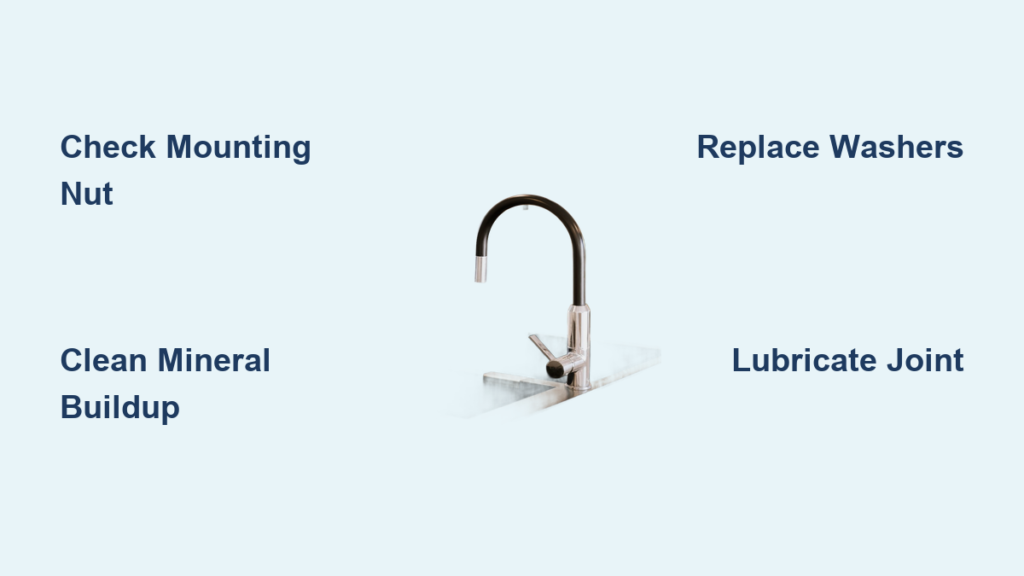
Access the mounting nut by opening your cabinet and locating the large hex nut securing the faucet base to the sink deck. Place a towel beneath to catch drips, then position your adjustable wrench on the nut. Have someone gently guide the faucet spout into its proper position while you tighten—most kitchen faucets face straight forward when centered. Turn the nut clockwise in quarter-turn increments, testing rotation after each adjustment. Stop when the faucet feels secure but still rotates smoothly—overtightening cracks porcelain sinks or strips plastic threads. This simple fix resolves swivel issues in 60% of cases.
Remove Mineral Buildup from the Swivel Mechanism
Hard water deposits silently accumulate inside swivel joints, gradually restricting movement until rotation stops completely. These chalky white or brownish deposits form where water evaporates in the narrow gap between the spout and faucet body. In areas with hard water, this process can freeze a faucet within two years of installation.
Disassemble the swivel mechanism by removing the set screw typically hidden beneath a decorative cap on the spout’s underside. Use penetrating oil if the screw resists turning—never force it. Lift the spout straight up to expose the spherical ball joint, which will likely show visible mineral accumulation. Soak the ball and surrounding cavity in white vinegar for 30 minutes, then scrub with an old toothbrush to loosen deposits. For stubborn buildup, wrap a vinegar-soaked paper towel around the joint and secure it with plastic wrap for several hours. Rinse thoroughly before reassembly to prevent vinegar from damaging rubber seals.
Replace Worn Swivel Washers and Retaining Clips

Worn rubber washers create the “spongy” feeling many homeowners describe when their faucet won’t swivel properly. These components maintain tension on the swivel ball while preventing water leakage. After years of compression and exposure to water, they harden, crack, or lose elasticity—allowing excessive play that leads to binding.
Identify the correct replacement parts by removing the old washer and taking it to a hardware store—faucet washers vary significantly between brands. Moen typically uses flat rubber washers, while Delta employs spring-loaded cartridges. When installing new components, apply plumber’s grease to all contact surfaces to prevent immediate wear. Test rotation after reassembling each component—this helps identify if you’ve missed a worn part or installed something incorrectly. Properly tensioned washers should allow smooth rotation with slight resistance, not complete free-spinning.
Apply Professional-Grade Lubrication Technique
Most homeowners overlook lubrication during faucet repairs, guaranteeing the problem returns within months. The right lubricant creates a protective barrier that repels water and minerals while reducing metal-on-metal friction. Food-grade silicone grease outperforms petroleum products by resisting washout and maintaining viscosity across temperature changes.
Apply lubricant using a toothpick for precision—dab small amounts on the swivel ball’s contact points, washer surfaces, and clip retention grooves. Use only enough to create a thin film; excess grease attracts debris that accelerates wear. Rotate the spout continuously during reassembly to distribute lubricant evenly throughout the mechanism. For premium protection, mix a small amount of PTFE (Teflon) powder with the grease—plumbers use this trick to extend swivel mechanism life by 50% in hard water areas.
Recognize When Professional Help Is Needed
Some swivel problems require professional intervention. If your faucet uses an integrated cartridge system where the swivel mechanism can’t be accessed without specialized tools, attempting DIY repair risks permanent damage. Similarly, severely corroded mounting hardware fused to the faucet body often requires cutting tools that most homeowners lack. Signs you need a plumber include water leaking into your cabinet when rotating the faucet or hearing grinding noises that persist after cleaning.
Professional repair makes financial sense when replacement parts exceed $50 or when your faucet model has discontinued components. Most plumbers charge $150-$250 for faucet repair, but this includes warranty protection and proper disposal of old parts. For high-end faucets or integrated sink systems, professional service preserves your warranty and prevents costly mistakes. Consider scheduling a professional tune-up annually if you live in an area with extremely hard water—this preventive maintenance costs less than emergency repairs.
Implement Preventative Maintenance Routine
Prevent future swivel problems with a simple monthly maintenance habit. After washing dishes, rotate your faucet through its full range of motion while running hot water—this flushes debris from the mechanism. Every three months, apply a drop of silicone lubricant to the swivel joint while rotating the spout. Annual deep cleaning prevents mineral buildup from becoming problematic.
Install a water softener if your home has hard water above 7 grains per gallon—this single upgrade prevents 80% of faucet mechanism failures. When choosing new faucets, select models with ceramic disc valves and stainless steel swivel joints, which resist corrosion better than plastic alternatives. Most importantly, never force a stiff faucet—excessive pressure damages internal components beyond repair. Address minor stiffness immediately with lubrication before it develops into complete failure.
A kitchen faucet that won’t swivel disrupts your entire kitchen workflow, but most repairs take less time than ordering takeout. By systematically diagnosing the cause and applying the right solution, you restore full functionality without professional help. Remember that regular maintenance prevents most swivel problems before they start—just five minutes of care each month saves hours of repair later. With these proven techniques, your faucet will rotate smoothly for years to come, making kitchen tasks effortless again. When stiffness returns, you’ll know exactly how to fix a kitchen faucet that won’t swivel—quickly, confidently, and completely.