Your kitchen faucet’s sprayer suddenly stops working right when you need it most—midway through rinsing vegetables or cleaning a greasy pan. You press the spray button, but nothing happens, or worse, water leaks from the base of the handle. This frustrating issue affects millions of homeowners every year, disrupting meal prep and kitchen cleanup routines. Whether your pull-down sprayer won’t retract properly, the spray pattern has become weak, or water continues flowing after releasing the trigger, these problems have straightforward solutions you can handle yourself. This comprehensive guide will walk you through diagnosing and fixing common kitchen faucet sprayer issues, saving you hundreds in unnecessary plumber fees. You’ll learn exactly what tools you need, how to identify the specific problem with your model, and complete repairs in under an hour with basic household tools.
Diagnose Your Specific Sprayer Problem Before Starting

Before grabbing your tools, properly identify which of the five common sprayer issues you’re facing. Each requires a different repair approach, and misdiagnosis leads to wasted time and unnecessary part replacements. Stand at your sink with the faucet running and methodically test each function while observing where problems occur.
Is Your Spray Head Clogged or Restricted?
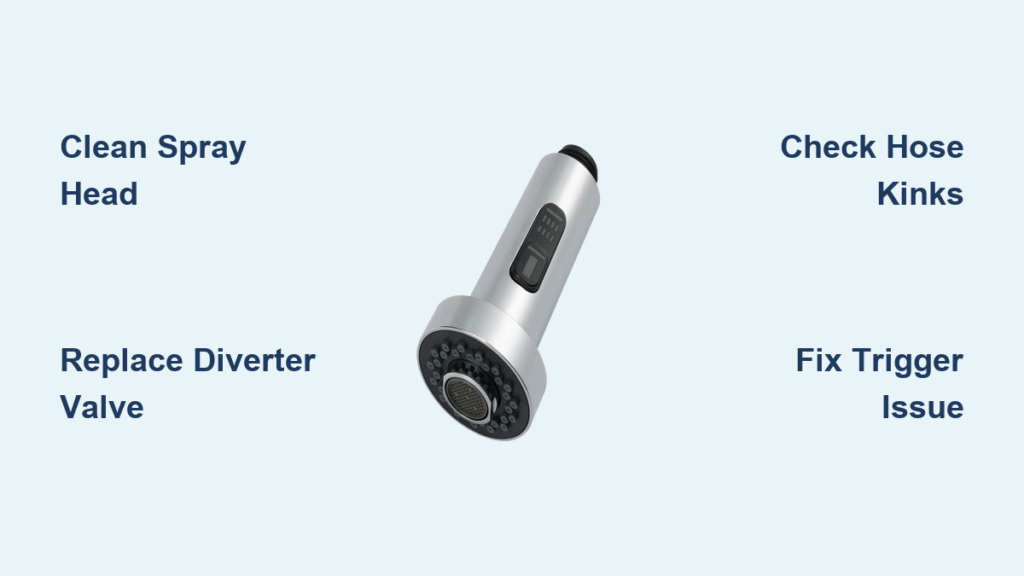
Signs your spray head is clogged: Water flows from the main spout but the spray function produces weak, uneven streams or no spray at all. You might notice some spray holes completely blocked while others work normally. This typically happens in areas with hard water where mineral deposits accumulate over time.
Quick test: Remove the spray head (most unscrew by hand) and run water directly through the detached head. If water flows freely without the head attached but poorly with it on, you’ve confirmed a clogged spray head rather than a hose or diverter issue. Soak the head in vinegar for 30 minutes, then use a toothpick to clear individual spray holes.
Why Water Leaks from the Faucet Base When Using Spray Mode
If water pools around your faucet base only when using the spray function, your diverter valve has failed. This small internal component redirects water from the main spout to the spray hose when you press the spray button. When worn out, it allows water to escape through the valve housing instead of traveling up the hose.
Critical warning: Ignoring this leak accelerates damage as water seeps into cabinet structures, potentially causing mold growth and wood rot within weeks. Shut off water supply immediately if you notice significant pooling under your sink after spray use.
Essential Tools and Parts for Sprayer Repairs

Gather These 7 Items Before Starting Any Repair
- Adjustable wrench (10-inch works for most faucets)
- Needle-nose pliers
- Replacement diverter valve (specific to your faucet model)
- Spray head replacement (if cleaning doesn’t restore function)
- Teflon tape (plumber’s tape)
- White vinegar and old toothbrush
- Small bowl for soaking parts
Pro tip: Take photos of your faucet assembly before disassembly. Many homeowners struggle during reassembly because they forget how components fit together. A quick phone picture saves hours of frustration later.
Fixing a Clogged Spray Head in 4 Simple Steps
Remove and Soak the Spray Head
Unscrew the spray head from the end of the hose by turning counterclockwise. Most require just hand strength, though some have a locking nut that needs a wrench. Place the head in a bowl filled with equal parts white vinegar and warm water. Let it soak for 30-60 minutes depending on mineral buildup severity.
Clear Individual Spray Holes
After soaking, use a toothpick or soft-bristled toothbrush to gently clear debris from each spray hole. Avoid metal tools that could scratch the finish. For stubborn clogs, insert a strand of dental floss through each hole to dislodge deposits without damaging the spray plate.
Replace Worn Spray Head Components
Many spray heads contain small internal filters and check valves that degrade over time. Open the head according to its design (some twist apart, others have retaining rings) and replace any cracked or brittle components. Most manufacturers sell rebuild kits for $8-15 that include all necessary washers and springs.
Test Before Reinstalling
Reassemble the spray head without fully tightening, then briefly turn on water to check for proper spray pattern and leaks. Adjust internal components as needed before securing completely. A properly functioning spray head should produce a consistent, even fan pattern without dripping when not in use.
Repairing a Faulty Diverter Valve System
Locate Your Diverter Valve Assembly
The diverter valve typically sits where the spray hose connects to the main faucet body. On pull-down faucets, it’s usually behind the handle assembly; on side-spray models, it’s in the base near the hose connection point. Consult your faucet’s model-specific diagram if available.
Remove the Old Diverter Valve
Shut off water supply valves under the sink. Place a towel in the sink basin to catch small parts. Use an adjustable wrench to remove the retaining nut holding the diverter assembly. Some models require removing the handle first—look for a decorative cap on top that pops off to reveal a screw.
Install the New Diverter Valve
Apply plumber’s tape to the threads of the new diverter valve before installation. Hand-tighten first, then give a quarter-turn with your wrench—overtightening cracks plastic components. Reconnect the spray hose to the diverter outlet, ensuring the hose isn’t kinked or twisted.
Troubleshooting Persistent Sprayer Issues

Why Your Spray Hose Won’t Retract Properly
A pull-down sprayer that hangs loosely instead of returning to its dock usually has a damaged spring mechanism inside the faucet neck. Remove the aerator and look up into the faucet spout with a flashlight. If the spring appears stretched or broken, you’ll need to disassemble the entire faucet to replace it—a more advanced repair requiring model-specific instructions.
Fixing a Spray Trigger That Stays Engaged
When the spray button remains “on” without holding it, the trigger mechanism has worn out. Disassemble the spray head to access the trigger assembly. Most contain a small spring that loses tension over time. Replace the spring or the entire trigger mechanism using parts from your faucet manufacturer.
Prevent Future Sprayer Problems With These Maintenance Habits
Monthly Sprayer Maintenance Routine
- Remove and soak spray head in vinegar solution for 15 minutes
- Wipe diverter valve connection points with a vinegar-dampened cloth
- Lubricate moving parts with plumber’s grease (never petroleum-based)
- Check hose for kinks or abrasion points against sink edges
When to Call a Professional Plumber
While most sprayer issues are DIY-friendly, seek professional help if you encounter:
– Significant leaks from the faucet base when water is off
– Cracks in the faucet body or spout
– Complete loss of water pressure to both spray and main spout
– Repairs that require specialized tools beyond basic wrenches
Final Fixes for Common Sprayer Complaints
Stop Spray Mode From Activating Accidentally
If your spray function engages when you don’t want it to, adjust the diverter valve tension. Some models have an adjustable screw on the diverter assembly—turn it clockwise slightly to increase resistance. For models without this feature, replace the diverter valve with one designed for higher activation pressure.
Eliminate Sputtering When Switching Between Modes
Air trapped in the spray hose causes annoying sputtering. Fix this by turning on both hot and cold water fully, then pressing the spray button repeatedly while water flows. This purges air from the system. If sputtering continues, check for partial clogs in the hose by disconnecting both ends and running water through it.
Pro Tip: Keep your original faucet manual in a kitchen drawer. Most manufacturers provide model-specific exploded diagrams showing every component—this saves hours of guesswork during repairs. If you’ve lost yours, search online using your faucet’s model number (usually found on the base or under the handle).
By following these targeted repair methods, you’ll restore full functionality to your kitchen faucet sprayer without unnecessary expense. Remember that 90% of sprayer issues stem from just three problems: clogged spray heads, worn diverter valves, or kinked hoses—each solvable with basic tools and under $20 in parts. Implement the monthly maintenance routine to prevent most future issues, extending your faucet’s lifespan by years. When repairs feel beyond your comfort level, don’t hesitate to consult a professional plumber—some complex cartridge replacements require specialized tools and expertise to avoid costly water damage.