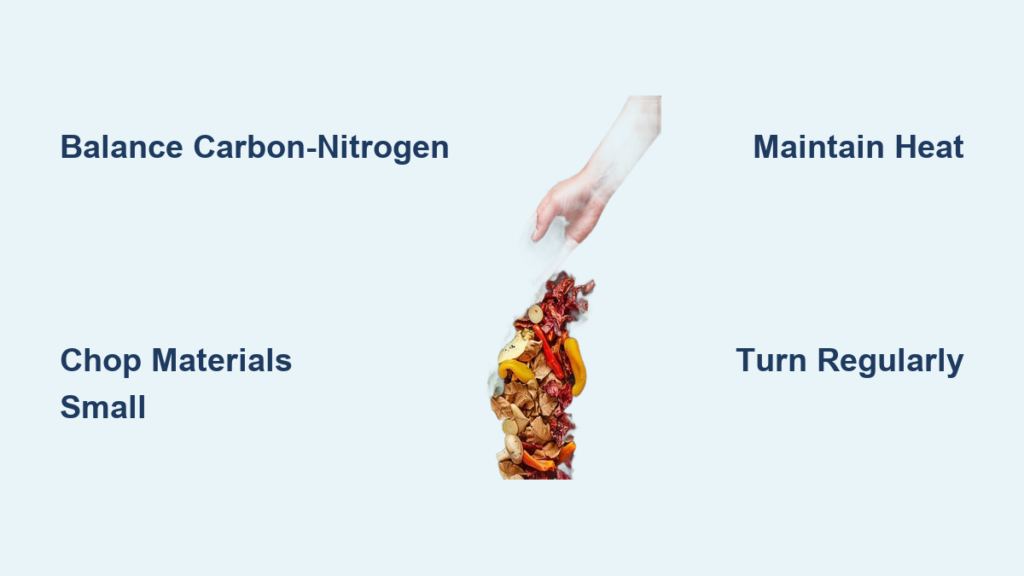
Kitchen waste piling up in your trash can while your garden craves nutrients? You’re not alone. Millions of households struggle with slow composting that takes months to produce usable material. But here’s the game-changer: with the right techniques, you can transform banana peels, coffee grounds, and vegetable trimmings into rich, finished compost in just 3-4 weeks instead of 6-12 months. The secret lies not in magic but in understanding and optimizing the biological processes that break down organic matter. This guide reveals proven methods to accelerate decomposition, avoid common pitfalls, and create “black gold” for your garden faster than you thought possible—whether you have a backyard or just a small apartment space.
Fix Your Carbon-Nitrogen Ratio Immediately
Your compost pile’s speed lives or dies by its carbon-to-nitrogen ratio. Kitchen scraps alone contain too much nitrogen, creating a soggy, smelly mess that decomposes slowly. The magic ratio for fast results? 25-30 parts carbon (browns) to 1 part nitrogen (greens). When balanced correctly, microorganisms multiply rapidly, generating heat that accelerates decomposition.
What to Add for Instant Balance
Kitchen waste needs substantial carbon supplementation to decompose quickly. Keep these brown materials handy:
– Shredded newspaper or cardboard (soaked first)
– Dry leaves (store autumn leaves for year-round use)
– Straw or hay (avoid fresh grass clippings)
– Coffee filters and unbleached paper towels
Add two to three handfuls of browns for every cup of kitchen scraps. If your pile smells ammonia-like or feels slimy, add more browns immediately. Proper balance means your compost should feel like a wrung-out sponge—not dripping wet, but not dry either.
Choose the Right Fast Method for Your Space
:max_bytes(150000):strip_icc()/hot-composting-step-by-step-guide-5186518_27-6633540680bb4280bfb057dc2b4b490d.jpg)
Not all composting methods deliver equal speed. Selecting the appropriate system for your living situation makes the difference between weeks versus months of waiting.
Hot Composting: The Speed Demon (Outdoor)
This method produces finished compost in 2-4 weeks but requires space and effort. Build a 3x3x3 foot pile all at once with equal parts greens and browns. Mix thoroughly, then monitor temperature with a compost thermometer. Turn the pile every 2-3 days when temperatures drop below 130°F. The intense heat (140-160°F) kills pathogens while accelerating decomposition. Ideal for gardeners with yard space who generate regular kitchen waste.
Bokashi Fermentation: Apartment-Friendly Speed
No outdoor space? Bokashi works indoors and processes all kitchen waste—including meat and dairy—in just 2 weeks. Layer scraps with inoculated bran in an airtight bucket, pressing out air each time. After 14 days of fermentation, bury the pre-composted material in soil for another 2 weeks to finish. The sealed system prevents odors while the fermentation process breaks down materials faster than traditional methods.
Chop Everything Before Adding
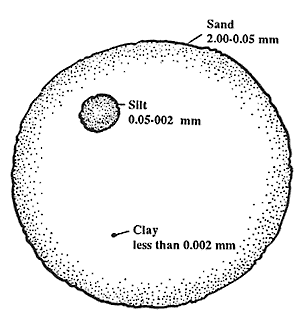
Particle size directly impacts decomposition speed. Whole banana peels take months to break down; quarter-inch pieces decompose in weeks. This isn’t just theory—smaller pieces expose more surface area to microorganisms, accelerating the process by 50% or more.
Speed-Boosting Prep Techniques
• Cut vegetable scraps into 1-inch pieces before adding to your bin
• Tear fruit peels into strips rather than adding whole
• Freeze scraps first—the freeze-thaw cycle ruptures cell walls for faster breakdown
• Blend tough materials like corn cobs into coarse puree
Avoid adding large items like whole potatoes or apples—they’ll sit in your pile for months while the rest finishes. A quick chop in your kitchen saves weeks of waiting.
Optimize Moisture and Oxygen Daily
Moisture and oxygen work together as the engine driving decomposition. Get these wrong, and even perfectly balanced materials decompose slowly.
The Perfect Moisture Test
Grab a handful of compost and squeeze firmly. You should get 1-2 drops of water—not a drip, not bone dry. Too wet? Mix in dry leaves or shredded paper. Too dry? Spray with water while turning. Kitchen scraps provide moisture, but browns often need pre-wetting—soak shredded paper in water for 10 minutes before mixing into your pile.
Aeration That Actually Works
Turn your pile every 2-3 days with a pitchfork or compost aerator tool. For tumblers, rotate daily. Proper aeration introduces oxygen that aerobic microbes need to thrive. Without it, your pile turns anaerobic, creating foul odors and slowing decomposition to a crawl. If turning seems daunting, insert perforated PVC pipes vertically into your pile for passive airflow.
Generate and Maintain Heat Strategically

Temperature is your secret weapon for fast composting. Microbial activity doubles with every 18°F temperature increase up to 140°F. A hot pile (130-160°F) decomposes materials 5 times faster than a cold one.
Build Heat-Retaining Piles
Start with materials at room temperature—cold kitchen scraps slow initial heating. Build your pile all at once to sufficient mass (minimum 3 cubic feet). Insulate the sides with straw bales in cool weather. Position your bin against a south-facing wall to capture solar heat. Monitor with a compost thermometer and turn when temperatures drop below 130°F to reignite the heating cycle.
Winter Composting Hacks
Don’t stop composting when temperatures drop. Insulate piles with black plastic to absorb heat. Add extra browns (they decompose slower, generating heat longer). Bury kitchen waste deep in the center where heat concentrates. Even in winter, the core of a well-insulated pile can maintain 90-100°F—enough for continued decomposition.
Solve These 3 Slow-Down Problems Immediately
Smelly, Slimy Pile Fix
Ammonia odors mean too much nitrogen and not enough carbon. Immediately mix in 3 parts dry leaves or shredded paper for every 1 part kitchen waste. Turn the pile thoroughly to introduce oxygen. Prevent recurrence by always covering new kitchen scraps with a 2-inch layer of browns.
Slow Decomposition Despite Proper Care
If your pile has good balance but still decomposes slowly, particle size is likely the culprit. Chop remaining materials smaller and remix into the pile. Alternatively, your pile may be too small—combine with a neighbor’s scraps to reach minimum size for heat retention.
Fruit Fly Invasion Solution
Cover all kitchen waste immediately with finished compost or soil. Bury scraps at least 6 inches deep. For severe infestations, sprinkle diatomaceous earth on top layers. Never add citrus peels or onion skins on the surface—they attract flies.
Maintain Momentum for Continuous Results
Fast composting requires system thinking, not just individual piles. Keep the process moving with these habits:
• Feed consistently – Add kitchen scraps at the same time daily to maintain microbial populations
• Store browns – Keep a container of shredded paper or dry leaves next to your kitchen bin
• Harvest promptly – When compost looks dark and earthy with no recognizable scraps, remove it to start a new batch
• Refresh bedding – Every 3 months, replace 25% of worm bin bedding with fresh material
Turn Scraps into Soil Gold in Record Time
You don’t need to wait months for compost. By mastering the carbon-nitrogen balance, selecting the right method for your space, chopping materials small, and maintaining optimal moisture and heat, you can transform kitchen waste into garden-ready compost in just 3-4 weeks. Start with one technique that fits your lifestyle—hot composting for yards, bokashi for apartments, or vermicomposting for steady output. Pay attention to the moisture test and turn your pile regularly. Within weeks, you’ll have rich, dark compost that nourishes your plants while keeping waste out of landfills. The fastest composters aren’t experts—they’re people who consistently apply these simple principles. Your kitchen scraps are waiting to become garden gold; all it takes is the right approach to make it happen quickly.