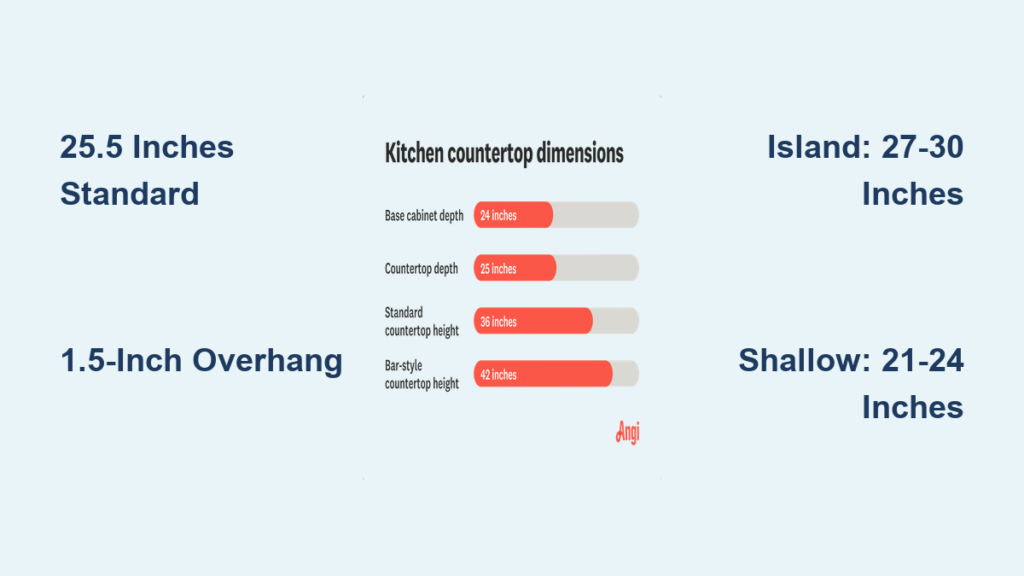
Ever lean across your kitchen counter to grab that spice jar only to knock over your coffee mug? That daily frustration likely stems from one critical measurement: how deep are kitchen counters in your home. The standard depth of 25.5 inches (measured from front edge to backsplash) represents the industry benchmark that balances workspace availability with ergonomic comfort for most households. This precise dimension isn’t arbitrary—it’s the result of decades of kitchen design refinement that accommodates standard 24-inch base cabinets while providing that crucial 1.5-inch overhang. Understanding these measurements helps you determine whether your current counter depth serves your needs or if adjustments could transform your kitchen workflow.
Choosing the wrong countertop depth creates more than minor inconvenience—it leads to chronic strain, wasted space, and daily frustration that compounds over time. Too shallow, and you’ll constantly battle limited workspace; too deep, and you’ll find yourself stretching for items near the backsplash or dealing with inaccessible “dead zones.” This guide cuts through the confusion by detailing exactly how deep kitchen counters should be for various applications, helping you make informed decisions whether you’re renovating, replacing countertops, or simply optimizing your current layout.
Why Your Standard Countertop Measures 25.5 Inches
The industry-standard 25.5-inch countertop depth directly corresponds to the 24-inch depth of standard base cabinets, with the additional 1.5 inches creating a functional overhang that serves multiple critical purposes beyond mere aesthetics. This precise measurement allows most adults to comfortably reach the back of the counter without straining while providing ample room for food preparation tasks and small appliances like coffee makers and toasters. When you’re standing at your counter preparing dinner, that extra inch and a half ensures your elbows don’t bump cabinet doors while keeping drawers fully accessible—a subtle but essential design consideration you’ll appreciate daily.
The Critical Role of the 1.5-Inch Overhang
That seemingly minor 1.5-inch overhang actually protects your cabinet investment in three vital ways you’ll notice only when it’s missing. First, it creates a barrier that prevents liquids from food preparation and cleaning from seeping directly against cabinet fronts, which would otherwise cause warping, staining, and finish damage over time. Second, it provides structural reinforcement that prevents heavier countertop materials like granite or concrete from sagging or cracking at the front edge. Third, it ensures smooth operation of cabinet doors and drawers by preventing them from catching on the countertop edge—a common frustration in kitchens with insufficient overhang that makes accessing lower storage awkward and inefficient.
Minimum Functional Depth for Daily Kitchen Tasks
Countertops measuring less than 24 inches deep create serious usability challenges that become painfully obvious during routine kitchen activities. At this minimum functional depth, even placing a standard toaster consumes nearly the entire usable surface, leaving insufficient space for actual food preparation in front of appliances. Most professionals recommend at least 24.5 inches to accommodate minor wall irregularities while maintaining adequate workspace. When you’re rolling out pastry dough or assembling ingredients for a family meal, that extra half-inch makes the difference between a functional workspace and one that constantly forces you to clear and reorganize—a daily frustration that adds unnecessary stress to cooking routines.
Kitchen Island Countertops: When Standard Depth Doesn’t Apply

Kitchen islands break free from perimeter counter constraints because they serve fundamentally different purposes, requiring deeper measurements to accommodate multiple users, larger workspaces, and often seating areas. While your perimeter counters prioritize efficient reach and cabinet access, your island needs to transform into a versatile hub that supports everything from elaborate meal prep to casual dining—necessitating a different depth calculation that directly impacts how you’ll use this central kitchen feature.
Optimizing Workspace Depth for Food Preparation
Most kitchen islands require 27 to 28 inches of countertop depth to provide genuinely functional workspace for food preparation tasks that standard counters can’t accommodate. This additional 2-3 inches creates meaningful workspace that allows two people to work side-by-side without crowding each other—a critical consideration if your island serves as the primary cooking surface. When you’re rolling out pie crusts or assembling multiple components for a complex recipe, that extra depth means ingredients and tools can be arranged logically rather than crammed into a narrow strip, transforming your cooking experience from cramped to comfortable.
Essential Depth Requirements for Island Seating
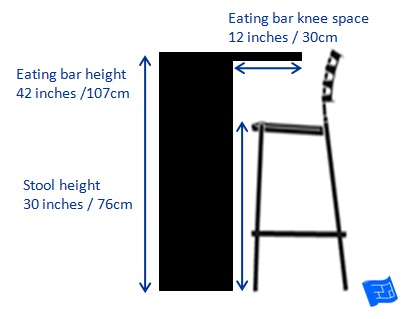
If your island includes a breakfast bar or casual seating area, countertop depth must increase to at least 30 inches to provide the necessary 15 inches of knee clearance for comfortable seating. Anything less creates an awkward dining experience where diners constantly bump their knees against the cabinetry underneath, making the space unusable for its intended purpose. For islands designed specifically as dining areas, depths of 32-36 inches accommodate larger seating arrangements while providing ample knee room—ensuring your island functions as both a practical workspace and comfortable gathering spot rather than forcing you to choose between the two.
When Deeper Countertops Make Sense for Your Kitchen
While 25.5 inches serves most households well, specific situations justify deeper countertops that exceed standard dimensions. Tall homeowners (over 6 feet) often benefit from the additional reach that 27-30 inch counters provide, while professional cooks or serious home chefs may require the expanded workspace for elaborate meal preparation. Larger kitchens with generous footprints can also accommodate deeper counters without making the space feel cramped—a crucial consideration if your kitchen layout has sufficient square footage to support the additional depth without compromising traffic flow.
Avoiding the Hidden Drawbacks of Deep Counters
Deeper countertops introduce significant trade-offs you must consider before committing to non-standard dimensions. Anything beyond 25.5 inches creates hard-to-reach “dead zones” near the backsplash where items disappear and cleaning becomes difficult—wasted space that actually reduces your functional workspace despite the larger measurement. For shorter users (under 5’6″), deeper counters force uncomfortable leaning and stretching during routine tasks, potentially causing chronic strain over time. The additional material also increases costs substantially—both for the countertop itself and for any necessary cabinet modifications—making deeper counters a decision that requires careful cost-benefit analysis rather than simple preference.
Shallow Countertops: The Space-Saving Compromise
In compact kitchens and galley layouts, standard 25.5-inch counters can overwhelm limited floor space, making 21-24 inch shallow countertops a practical solution that improves traffic flow and creates a more open feel. These reduced depths work particularly well in narrow kitchens under 10 feet wide, where every inch of clearance matters for safe movement between work zones. If you’ve ever felt like your kitchen resembles an obstacle course during meal prep, shallow counters could transform your workflow by eliminating the constant bumping into countertops that plagues cramped spaces.
Recognizing the Functional Limitations
Shallow countertops come with significant functional trade-offs that become apparent during daily use. With less than 24 inches of depth, even standard appliances like coffee makers consume disproportionate workspace, forcing constant clearing and reorganization during meal preparation. The reduced surface area limits your ability to spread out ingredients for complex recipes and creates workflow bottlenecks that frustrate serious cooks. Consider shallow counters only when space constraints make standard depths physically impossible—recognizing this as a necessary compromise rather than an ideal solution for functional kitchen design.
Key Factors That Determine Your Ideal Countertop Depth
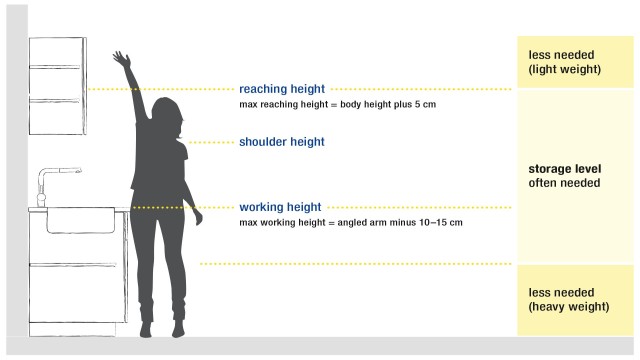
Your perfect countertop depth depends on more than industry standards—it must align with your specific kitchen layout, physical needs, and cooking habits. The 25.5-inch standard works for most people because it matches average comfortable reach distance, but your ideal depth may differ based on how you actually use your kitchen space. Before finalizing any countertop decision, evaluate these critical factors that directly impact your daily experience at the counter.
Matching Countertop Depth to Your Physical Reach
Stand at your current counter and notice how far you comfortably reach toward the backsplash during food prep—this natural reach distance should determine your ideal counter depth. If you frequently find yourself leaning forward or stretching uncomfortably to access items near the wall, your counter is likely too deep for your height and build. Conversely, if you constantly bump your hips against the counter edge while working, the depth may be insufficient for your body mechanics. The ideal depth allows you to work with arms slightly bent and back straight—a posture that prevents strain during extended cooking sessions.
Ensuring Proper Appliance Compatibility
Your countertop depth must accommodate the appliances you actually use, not just theoretical standard sizes. Measure the depth of your most frequently used countertop appliances (coffee maker, toaster, mixer) and ensure your counter provides at least 6 inches of workspace in front of them for functional use. For islands incorporating sinks or cooktops, verify that the depth provides adequate clearance on all sides—typically 18-24 inches on either side of a sink and 30 inches in front of a cooktop for safe operation. Ignoring these practical clearance requirements creates a beautiful but dysfunctional kitchen that fails to support your actual cooking habits.
| Countertop Type | Standard Depth | Best For |
|---|---|---|
| Standard Kitchen Counters | 24-25.5 inches | Most residential kitchens |
| Kitchen Islands (no seating) | 27-28 inches | Enhanced food preparation |
| Kitchen Islands (with seating) | 30+ inches | Breakfast bars and dining |
| Deep Custom Counters | 27-30 inches | Tall users or large kitchens |
| Shallow Counters | 21-24 inches | Compact or galley kitchens |
Choosing the right countertop depth requires balancing industry standards with your specific needs and space constraints. The 25.5-inch standard works for most households because it accommodates standard cabinetry while providing ergonomic functionality, but your ideal depth may differ based on your kitchen layout, height, and cooking habits. Before finalizing any countertop decision, measure your current workspace usage patterns and test different depths with temporary mockups—this small investment of time prevents costly mistakes and ensures your countertops actually support your kitchen workflow rather than hindering it. Remember that the perfect countertop depth disappears into the background of your cooking experience, becoming an invisible asset that makes daily kitchen tasks feel effortless rather than a constant source of frustration.