Trying to remove screws from kitchen cabinets often turns into a frustrating battle against paint-sealed heads, stripped slots, and rusted fasteners. This common DIY challenge leaves many homeowners staring at stubborn hardware with a screwdriver in hand, wondering how to proceed without damaging their cabinetry. Whether you’re updating cabinet hardware, repairing damaged doors, or preparing for a kitchen remodel, knowing exactly how to remove screws from kitchen cabinets safely and effectively saves time, prevents costly damage, and eliminates unnecessary stress. The good news is that with the right techniques and tools—many of which you likely already own—you can conquer even the most stubborn cabinet screws.
Kitchen cabinet screws become difficult to remove for several predictable reasons: layers of paint from previous renovations sealing the heads, moisture-induced corrosion in the humid kitchen environment, over-tightening during initial installation, or simply the mechanical bond created by years of undisturbed service. Each scenario requires a specific approach, and using the wrong technique can transform a simple task into a cabinet-damaging disaster. This guide provides field-tested methods for every common cabinet screw removal challenge, helping you select the perfect solution for your specific situation.
Diagnose Your Specific Screw Removal Challenge
Before grabbing tools, identify exactly why your cabinet screws won’t budge—this determines your best removal strategy. Different problems require different solutions, and misdiagnosis leads to wasted effort and potential damage.
Is Paint Sealing Your Screw Heads?
Paint accumulation represents the most common reason kitchen cabinet screws resist removal. During repainting, paint flows over screw heads and into slots, creating an adhesive seal that prevents proper tool engagement. If your screw heads appear smooth with no visible slots, or if the screwdriver slips immediately upon contact, paint sealing is likely your problem. The solution requires careful paint removal before any extraction attempt.
Are Your Screw Heads Stripped or Rounded?
Stripped screw heads occur when previous removal attempts damaged the slots, leaving rounded edges that prevent screwdriver engagement. If your screwdriver slips out repeatedly despite using what seems like the correct size, or if the head shows visible damage from previous attempts, you’re dealing with a stripped head. This scenario demands specialized extraction techniques beyond standard screwdriver use.
Is Rust or Corrosion Freezing Your Screws?
Kitchen moisture creates ideal conditions for corrosion, especially around sink areas. If your screws show visible rust around the head or threads, or if they resist movement despite proper tool engagement, corrosion has likely bonded the screw to surrounding material. This requires chemical penetration combined with thermal expansion techniques for successful removal.
Use These Essential Tools for Cabinet Screw Removal

Having the right tools on hand before starting prevents frustration and cabinet damage. Don’t attempt stubborn screw removal with inadequate equipment—this almost always leads to worse problems.
For standard screw removal:
– Quality screwdrivers with magnetic tips (both Phillips and flathead)
– Utility knife for paint removal
– Penetrating oil (WD-40 or PB Blaster)
– Soft-bristle brush for slot cleaning
For stripped or broken screws:
– Screw extractor set with multiple sizes
– Locking pliers (Vise-Grips)
– Rubber bands (for temporary grip enhancement)
– Dremel tool with metal-cutting disc
For rusted screws:
– Heat gun or hair dryer
– Hammer and nail punch
– Dental picks for precision work
Remove Standard Cabinet Screws Without Damage
When screw heads remain intact with clear slots, proper technique prevents the stripping that creates bigger problems.
Clear paint from screw slots first—this critical step prevents immediate stripping. Use a sharp utility knife to carefully score around the screw head perimeter, breaking the paint seal. Then, use a dental pick or safety pin to remove dried paint from within the slots themselves. Even small paint remnants prevent full screwdriver engagement, causing slippage and damage during removal attempts.
Select the perfect screwdriver fit—a loose fit guarantees stripped heads. Test multiple screwdriver sizes until you find one that fits snugly in the screw slots with no wiggle room. Press the screwdriver firmly into the slots while applying steady counterclockwise pressure. Maintain forward pressure throughout rotation to prevent the tool from riding up and out of the slots.
Apply penetrating oil for resistance—if the screw shows any resistance during turning, stop immediately and apply penetrating oil to the head and surrounding area. Allow 15-30 minutes for penetration before resuming. When movement begins, continue turning without pausing to prevent threads from reseating themselves.
Extract Stripped or Rounded Cabinet Screws
Stripped screw heads require specialized approaches beyond standard screwdriver techniques. Attempting conventional removal on damaged heads almost always worsens the problem.
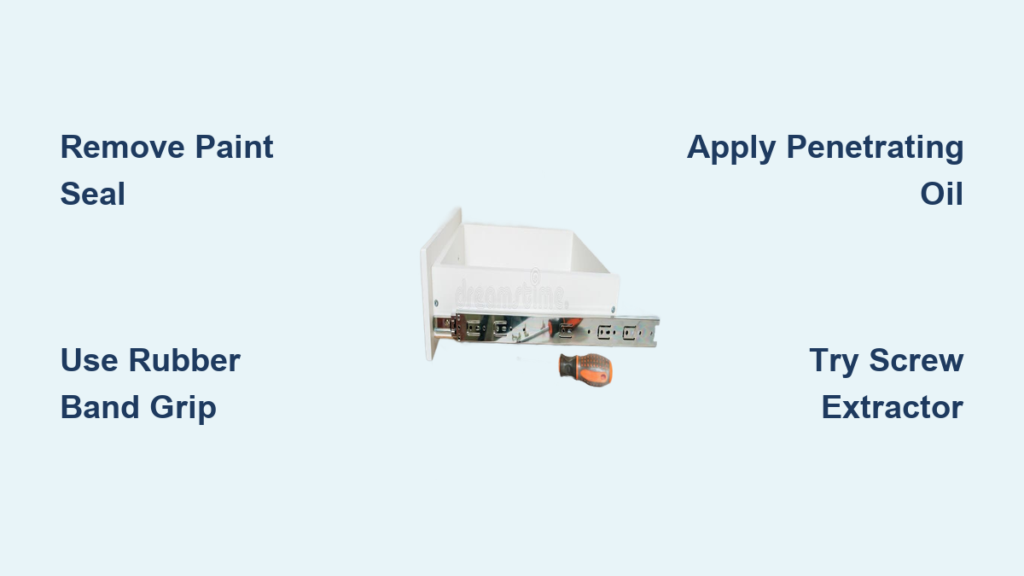
The rubber band method works for minor stripping—place a wide rubber band across the screw head, then press your screwdriver firmly through the rubber band into the damaged slots. The rubber fills gaps and provides additional friction for grip. Apply steady counterclockwise pressure while maintaining firm downward force on the screwdriver. This surprisingly effective technique requires no special tools and works for 70% of mildly stripped cabinet screws.
Screw extractors handle severe damage—for completely rounded heads, select an extractor bit matching the screw size. Position it in the center of the damaged head and tap firmly with a hammer to create a starter indentation. Using a ratchet adapter, turn the extractor counterclockwise while applying firm downward pressure. The extractor’s reverse-tapered design bites into the screw head and gradually backs it out. This process requires patience—the extractor must cut new threads into the damaged material.
Vise-Grips rescue broken-off screws—when screw heads snap off completely, position locking pliers perpendicular to the remaining shank, clamping firmly just above the surface. The serrated jaws grip the hardened steel, providing rotational leverage. Turn counterclockwise while maintaining firm clamping pressure. This method works best when even a small portion of the screw shank remains visible.
Free Rusted and Corroded Cabinet Screws
Corrosion creates a mechanical bond that standard removal methods cannot overcome. Breaking this bond requires a systematic approach combining chemical penetration and controlled mechanical force.
Apply penetrating oil generously—use products specifically designed for rust penetration like PB Blaster, which features advanced capillary action that wicks into tighter spaces than standard WD-40. Allow minimum 30 minutes penetration time; for severe corrosion, overnight application often proves necessary. Reapply if you notice evaporation.
Apply heat strategically—use a hair dryer on medium heat for 30-60 seconds to soften surrounding paint and create thermal expansion. The combination of oil penetration and heat often frees screws that would otherwise require destructive extraction. Attempt removal immediately while the area remains warm.
Create new grip surfaces when needed—for screws that remain frozen, use a Dremel tool to cut a new slot across the screw head with a metal-cutting disc. This transforms a damaged head into a flathead-style slot, providing fresh engagement points for screwdriver removal.
Prevent Future Cabinet Screw Removal Problems
Proactive measures during installation or maintenance significantly reduce future removal difficulties.
Apply anti-seize compound during installation—a thin layer on screw threads prevents corrosion bonding and reduces friction during future removal. Graphite-based compounds work well for general applications in kitchen environments.
Mask screw heads during painting—apply small pieces of painter’s tape over screw heads before any repainting project. This simple step prevents paint from flowing into screw slots, eliminating the most common cause of difficult removal.
Invest in quality hardware—budget screws often use softer steel that strips more easily. Screws with square-drive (Robertson) designs strip less frequently than standard Phillips heads, making future removal significantly easier.
Repair Screw Holes After Successful Removal

After removing stubborn screws, proper hole repair ensures secure reinstallation of hardware or cabinet components.
Fill unused holes with matching material—apply wood filler in thin layers, sanding between applications for smooth results. For deep holes, use wooden dowels coated in wood glue to reduce shrinkage and provide stable repair material.
Reinforce stripped holes—for holes that will receive new screws but have lost holding power, insert wooden toothpicks coated in wood glue or specialized hole repair kits. Allow complete drying before drilling new pilot holes.
Touch up surrounding areas—test matching stain or paint in an inconspicuous area first, then apply to any blemishes around screw locations. Minor imperfections often disappear with proper finish application.
Removing screws from kitchen cabinets challenges homeowners daily, but these proven techniques provide solutions for every scenario. By matching your approach to the specific problem—whether paint sealing, stripped heads, or corrosion—you can successfully extract even the most stubborn cabinet screws without damaging your cabinetry. The key lies in proper diagnosis, using the right tools, and applying patience rather than excessive force. When in doubt, remember that heat, penetrating oil, and the rubber band trick solve most common cabinet screw removal challenges. With these methods in your toolkit, future cabinet hardware updates or repairs will become simple, straightforward tasks rather than frustrating battles against stubborn fasteners.