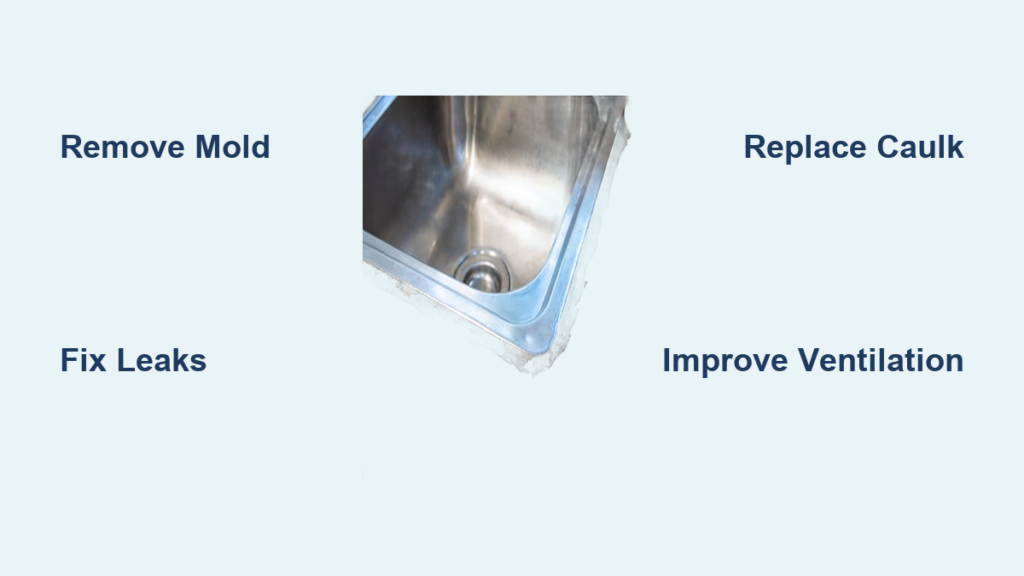
That black or green growth creeping along your kitchen sink’s edges isn’t just an eyesore—it’s a sign of moisture problems that can compromise your home’s air quality and structural integrity. When you discover mold around your kitchen sink, you’re facing more than a simple cleaning task; you’re dealing with a moisture issue that will keep returning until you address both the visible growth and the hidden conditions feeding it. Learning how to get rid of mold around kitchen sink areas properly requires understanding why it forms in this specific location, taking appropriate safety measures, selecting the right cleaning approach for your situation, and implementing prevention strategies that stop recurrence.
Kitchen sinks create perfect mold breeding grounds through constant moisture exposure from dishwashing and handwashing, combined with organic food particles that feed mold spores and often inadequate ventilation that traps humid air. Whether you’re dealing with minor discoloration on your sink caulk or extensive growth beneath your cabinet, this guide provides actionable steps to eliminate current mold problems and prevent future outbreaks. You’ll discover which natural solutions work best for mild cases, when commercial products are necessary, and how to identify hidden moisture sources that cause recurring mold issues.
Why Mold Grows Around Kitchen Sinks
Kitchen sinks provide the perfect mold habitat by combining three essential elements: moisture, organic food sources, and warm temperatures. Water constantly pools where the sink basin meets the countertop, collects along sealant lines, and accumulates under the sink where undetected leaks create dark, undisturbed conditions ideal for mold. This persistent moisture combines with organic matter—food particles, soap residue, skin cells, and dust—that naturally accumulates in these same areas, providing exactly what mold spores need to thrive.
Poor ventilation dramatically worsens the problem by trapping humid air instead of exhausting it outside. When you cook, run the dishwasher, or boil water, steam fills your kitchen. Without adequate ventilation through range hoods or exhaust fans, this moisture settles on cool surfaces around your sink, creating sustained humidity levels that allow mold colonies to establish and survive between cleanings.
The most vulnerable spots include the silicone caulk sealing where your sink rim meets the countertop, the sealant around your faucet base, tile grout lines if you have a backsplash, corners inside the sink basin, and—most problematically—the cabinet space beneath your sink where hidden leaks create extensive mold colonies. Each location requires specific cleaning approaches because mold behaves differently on porous versus non-porous surfaces.
Protect Yourself Before Cleaning

Mold cleanup involves disturbing mold spores that become airborne and can affect your health, so proper protection is non-negotiable. Start with an N95 respirator mask—simple dust masks provide virtually no protection against mold spores. For extensive cleaning or heavy mold growth, upgrade to a P100 respirator for superior filtration. This small investment protects your lungs from dangerous inhalation hazards during the remediation process.
Eye protection prevents cleaning solution splashes and airborne particles from contacting your eyes. Safety goggles that seal around your eyes work better than regular glasses with open sides, which leave gaps where particles can enter. Rubber gloves made of nitrile or neoprene protect your hands from both mold exposure and harsh cleaning chemicals—ordinary latex gloves degrade when exposed to many cleaning agents.
For large mold problems covering more than ten square feet, consider additional containment measures. Seal off your work area with plastic sheeting and tape, use a HEPA filter air purifier in the room, and wear disposable coveralls that you can remove and discard after cleaning. These precautions prevent spores from spreading to other areas of your home during the remediation process.
Assess Your Mold Problem Scope

Not all mold problems require the same approach—knowing what you’re dealing with determines whether DIY methods will work or professional help is needed. Surface mold on non-porous materials like ceramic sinks or stainless steel typically responds well to cleaning. This mold appears as discoloration that wipes away relatively easily, though it will return if underlying moisture persists.
Penetrating mold in porous materials presents a different challenge. When mold has grown into caulk, grout, or wood, wiping alone won’t remove it—the mycelium threads extend below the surface. If scrubbing doesn’t remove discoloration or it quickly reappears after cleaning, the material likely needs replacement rather than mere cleaning.
The size of the affected area provides crucial guidance. Mold covering less than ten square feet can typically be handled by homeowners, while areas larger than ten square feet, mold inside wall cavities, or suspected black mold (Stachybotrys chartarum) warrant professional evaluation. Hidden mold often reveals itself through musty odors, water stains on surrounding surfaces, or discoloration visible through cabinet walls.
Natural Cleaning Solutions for Mild Mold
For small mold problems on non-porous surfaces, household staples provide effective, safe cleaning options. White distilled vinegar kills approximately 82% of mold species on contact. Apply undiluted vinegar directly to affected areas using a spray bottle, let it sit for at least one hour (overnight for stubborn growth), then scrub with an old toothbrush and wipe clean. The strong smell dissipates within hours and poses no health risks in food preparation areas.
Baking soda combined with hydrogen peroxide creates a powerful cleaning paste that tackles both mold and stains. Mix to form a thick paste, apply to moldy surfaces, and let sit for several minutes. The foaming action lifts mold from surface irregularities while baking soda provides gentle abrasive action for scrubbing—ideal for sink basin corners and faucet bases.
Tea tree essential oil offers natural antifungal properties with a pleasant scent. Mix two teaspoons of tea tree oil with two cups of water in a spray bottle, apply generously, and let dry on surfaces for continued mold inhibition. While more expensive than vinegar, its residual protection makes it valuable for prevention.
Commercial Cleaners for Stubborn Mold

When natural solutions prove insufficient, commercial products offer stronger action. Hydrogen peroxide cleaners (3% concentration) work faster than natural alternatives and often require only five to ten minutes of contact time before wiping clean. Products like Clorox Hydrogen Peroxide Cleaner include surfactants that help the solution cling to vertical surfaces where liquids would otherwise run off.
Bleach solutions kill surface mold effectively but cannot penetrate porous materials. Use a solution of one cup bleach per gallon of water on non-porous surfaces, ensuring adequate ventilation and never mixing with ammonia or other cleaners (which produces toxic gas). Bleach works best as part of a comprehensive approach that includes addressing moisture sources.
Specialized mold and mildew cleaners like RMR-86, Mold Armor, and Concrobium come in spray, gel, or foam formulations. Gel formulations prove particularly valuable for vertical surfaces, as they cling where liquids would run off. Look for EPA-registered disinfectants and carefully follow label directions for optimal results and safety.
Complete Cleaning Step-by-Step
Successful mold removal follows a systematic process that ensures thorough treatment while minimizing spore spread. Begin by preparing your work area—cover nearby surfaces with plastic sheeting, open windows for ventilation, and ensure your protective equipment is in place.
Remove loose mold debris using a dry brush or HEPA-filter vacuum before wet cleaning. This initial dry removal prevents mold from being smeared around and reduces the overall spore load. Place debris in sealed plastic bags for disposal—standard vacuums without HEPA filters simply exhaust spores back into the air.
Apply your chosen cleaning solution generously to all affected surfaces, ensuring complete coverage including edges and corners. For natural solutions like vinegar, allow at least 30 minutes of contact time; for commercial products, follow label directions. After the contact period, scrub surfaces thoroughly with appropriate brushes—use toothbrushes for caulk lines and tight corners.
Rinse all treated surfaces thoroughly with clean water. For food preparation areas, a final rinse with dilute vinegar solution (one part vinegar to three parts water) neutralizes residue and provides additional disinfection. Complete drying is essential—use clean, dry cloths to wipe surfaces, then promote air circulation with fans. For moisture-prone areas like caulk lines, a hair dryer on low heat accelerates drying.
Find and Fix Hidden Leaks
Mold that keeps returning indicates a hidden moisture source. Inspect all connections under your sink while water is running—check supply line connections at shutoff valves and faucet inlets, drain pipe connections at the P-trap, and the garbage disposal unit. Place dry paper towels under connections and run water to reveal even small leaks that accumulate slowly but create significant mold problems over time.
Check the sink basin itself from below by feeling for moisture while someone sprays water into the sink above. A deteriorating sink basket gasket or worn faucet escutcheon can allow water to seep through to the cabinet below. Examine cabinet floors and walls for water stains, discoloration, or soft spots indicating ongoing moisture exposure.
Repair identified leaks immediately by shutting off water supply, disassembling the affected fitting, applying plumber’s tape to threaded connections, and reassembling securely. For damaged components like corroded shutoff valves or deteriorating supply lines, complete replacement is typically necessary.
Replace Caulking and Sealant
When mold has penetrated sink caulking, cleaning alone cannot resolve the problem—the mold has grown into the material itself. Remove old caulk using a utility knife or caulk removal tool, working carefully to avoid damaging surrounding surfaces. Clean the area thoroughly with mold-killing solution and allow it to dry completely—trapped moisture beneath new caulk will cause immediate regrowth.
Apply new mold-resistant caulk according to manufacturer directions. Mold-resistant silicone formulations provide the longest protection in wet environments. Cut the caulk tube tip at a 45-degree angle, apply steady pressure for a continuous bead without gaps, and tool the freshly applied caulk to create a smooth, water-shedding surface. Allow the caulk to cure for 24-48 hours before exposing it to water.
Stop Mold From Coming Back
Wiping down sink surfaces after each use prevents the sustained moisture accumulation that allows mold to establish. Pay particular attention to corners, sealant lines, and areas where water pools. Address leaks promptly—even small drips can create significant mold growth over time.
Improve kitchen ventilation by using exhaust fans during and after cooking, opening windows when weather permits, and ensuring range hoods vent to the exterior. In kitchens without adequate natural ventilation, running dehumidifiers during humid seasons maintains moisture levels below the 60% relative humidity threshold that supports mold growth.
Establish regular cleaning schedules—weekly wiping of sink areas with mold-inhibiting solutions removes spores before they establish colonies. Monthly inspection of caulking and hard-to-reach areas catches early growth when it remains easily treatable.
Know When to Get Professional Help
Certain situations exceed DIY capabilities. Extensive mold growth covering more than ten square feet requires professional remediation due to the enormous number of spores released during cleaning. Hidden mold growth inside wall cavities demands professional assessment using thermal imaging cameras and moisture meters.
Any suspected black mold warrants professional evaluation, as disturbing large areas without proper precautions can release dangerous concentrations of mycotoxins. Significant water damage accompanying mold growth indicates problems beyond surface cleaning that require professional water damage restoration.
Professional mold remediation ensures complete removal, addresses hidden moisture sources, and provides documentation valuable for insurance purposes. When problems exceed what you can safely address, calling professionals protects both your health and home investment.
Getting rid of mold around kitchen sink areas permanently requires treating both symptoms and causes. By understanding why mold grows there, protecting yourself during cleanup, choosing appropriate cleaning methods, addressing hidden moisture sources, and implementing prevention habits, you eliminate current mold problems and significantly reduce the likelihood of their return. The effort you invest in thorough remediation pays dividends in improved indoor air quality and a healthier kitchen environment.